
Further to the post below that illustrates the amount of mid-rise development going through the Urban Design Panel in Vancouver, it occurred to me that this is nothing new. Well-designed medium-rise development, typically five storeys or less, has made up a large part of the housing supply for decades. Region-wide, I wouldn’t be surprised if it constituted a very large part of the new housing stock.
But the cliché is all about Vancouverism – the highrise-and-podium form generated in the central area in the 1990s – and the disdain held by neighbourhood activists who object to this scale being imposed upon low-rise neighbourhoods. While it’s argued by Patrick Condon and others that we could comfortably accommodate growth without resorting to towers, the dilemma for planners is that reality departs from theory when it comes to site assembly or rezoning of land sufficient to handle projected growth without intruding deeper into single-family neighbourhoods beyond a block from arterial streets.
In any event, time for a new series: good examples of medium-rise development in Vancouver and elsewhere. Let’s start where good design is most achievable: in the affluent neighbourhoods where there is a limited stock of such opportunities.
A few isolated examples in West Vancouver, here on Marine Drive at the west end of Ambleside at 19th (map here):

.
And Hollyburn Centre at Marine Drive and 17th (map here)

.
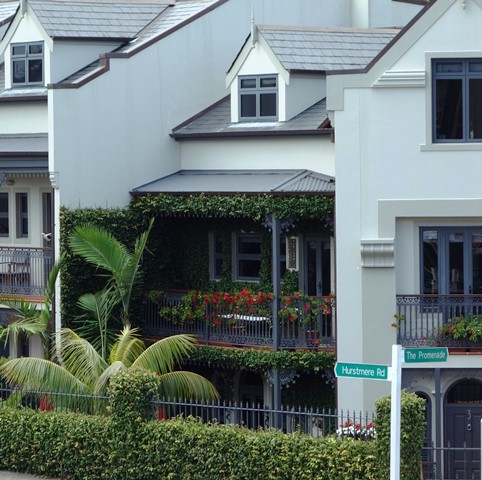
A comparative example Down Under in Takapuna, a district in Auckland (map here):

.
A sign of success: individual care of a semi-private space that relates to the public realm:
 .
.
Send in your own examples.





Aren’t those low-rise (about 4 or 5 storeys and under?)
I thought Olympic Village (and much of Richmond) was mid-rise (say, under 15 storeys).
Vancouver has some successful neighbourhoods where density has penetrated far beyond the 1-block radius.
Look at Kerrisdale for example. There are examples of low, mid and moderate high rise buildings in a huge area bounded by 37th & 45th, Larch & West Boulevard. The tallest buildings are all set back away from the commercial streets which retain more of a small town feel as a result. Despite the absence of a large grocery store the area is a magnet for people.
The top of the 4th Avenue hill in Kitsilano is another place where the arterial is lined with low shops while mid rise and even a few small towers rise on nearby streets. It has to be one of the most successful shopping streets in the whole city and the area is highly desirable.
I see areas like that as proof that increasing density 2-4 blocks off the arterial can be as good or better than creating a high walls on either side of our main streets.
Good examples but this is Low Rise. For me, mid rise starts at 5 or 6 storeys and up to 10…maybe 11, except when in point block tower form. Cambie corridor is mid rise.
A little bit taller than your examples, but since it came up recently, how about the redeveloped Oslo waterfront:
https://no.wikipedia.org/wiki/Fil:Tjuvholmen_start_park.JPG
Driving around European cities shows me that dense “sustainable” development can be done without going over five or six stories. Paris, London, Madrid, Munich, Berlin, Brussels are all very dense yet there is hardly any residential highrises. Why is Vancouver following a more Asian densification model, I.e highrises than a European model ?
Because the redevelopment of single family neighbourhoods was defeated 40 years ago. And today, while some people don’t like towers, many of them don’t like anything else either. The plan to build row homes and apartments in Marpole was not received at all well so the city backed down. Thin streets received a simlar reaction. Building anything, no matter how short it can be challenging.
As well, note that pretty much all the cities you mentioned above are building or are planning on building towers partly to address affordability problems.
Agreed.
The highrises are going on “opportunistic” (historically consolidated) large development sites (i.e supermartket sites, Oakridge, former light industrial and institutional sites).
Single family homes are not (yet) being demolished for highrises, just for lowrises and midrises.
Traffic noise. Yet another reason for cities to allow more homes to be built away from busy streets.
http://m.theatlanticcities.com/commute/2012/09/road-noise-deadly-maybe-annoying-definitely/3235/
Building towers to solve an affordability problem is catastrophic. An entire field of crime prevention (CPTED and defensible space) emerged out of high rise, low income towers in the 50s and 60s. We still have those monstrosities with us today. A decade ago we intervened in one in Toronto’s Jane/Finch. It took us years to cut the crime problems in those – and still haven’t done it. Let’s not repeat history!
What nonsense. It is pretty obvious that towers are not the problem. The problem is poorly designed buildings and communities. The height does not matter. There are plenty of areas in cities around the world that have crime problems where the building are only one or two stories tall. Yet no one ever seems to claim that we should stop building one story buildings everywhere just because some area a problem elsewhere.
There are plenty examples in this region and around the world of communities with towers that are pretty safe from crime. The idea that they will become somehow crime infested is just fearmongering.
Richard – thanks for puncturing that hoary old myth. If the form alone created the problem we would have crime- ridden slums all over downtown, the west end, Kerrisdale and South Granville, which is clearly not true.
Locally in planning jargon, the term midrise is being stretched from the 4-5 storeys of past decades (not 3 as in the pix, definitely low rise) up to 10-12. By the latter definition, the 12-storey residential buildings in Kerrisdale and South Granville – same zoning, BTW – are at the upper end of midrise.
But, as in all things relating to city- building, context matters. In an area with lots of buildings 6-10 storeys tall, like Hastings Street east, a midrise classification might even be a bit taller than 12 storeys.