

A ‘Policy Note‘ from our Economist Down the Street at the CCPA:
.
Density, condos and housing affordability
.
How is it that we have seen a non-stop construction boom in Vancouver over the past decade-plus and yet we still have huge homelessness and affordable housing problems? In the Figure, based on data from the BC Economic Accounts, it’s pretty clear that as a society we spend a lot building new housing.
It varies cyclically but over the past decade, BC has consistently spent more than 8% of its income (GDP) on residential construction, and in some years (like 2007) almost 10%. Between 1981 and 2012, the lowest that figure ever got was 5% of our GDP. To put that in dollar terms, BC spent $19.5 billion on new housing in 2012.
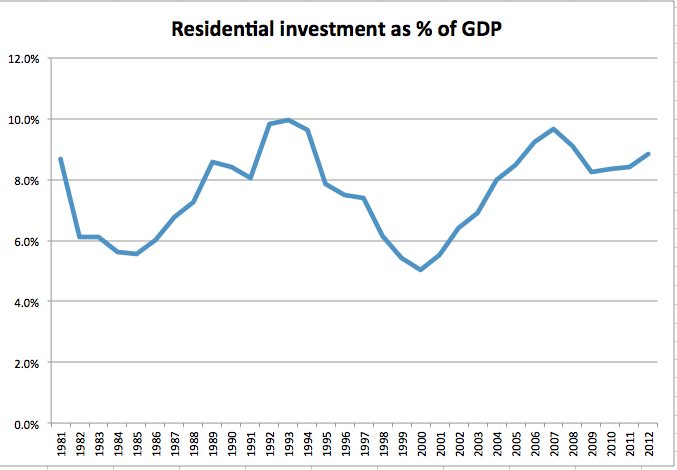
So it’s not like we are are failing to build new housing. The problem is that there’s a fundamental mis-match here between what we need in terms of new housing and what we are getting. Much of the conversation around housing affordability has been around the need for densification to accommodate new people coming to Vancouver, and this has set off pitched battles about what that density looks like. But the more important issue is what kind of housing we are building, and for whom.
Earlier this year, the Organization for Economic Cooperation and Development (OECD, a policy think tank of the rich advanced countries), put its finger on the problem. Its economic survey of Canada comments (p. 16):
Multi-unit housing construction has increasingly favoured condominiums over purpose-built rental buildings over the past decade. Although a significant share of condominiums in major cities is rented out, they typically have higher rents and represent a less stable housing supply for tenants.
The survey summarizes a more detailed research paper, Deconstructing Canada’s Housing Markets, that is well worth a read. It suggests some reasons for this dynamic (p. 32):
Private developers have favoured condominium development over purpose-built rental buildings because of the higher returns and lower risk involved. Condominium units can be presold, whereas purpose-built rental buildings must be fully constructed before being rented out. … [as well as] preferential tax treatment of owner-occupied housing, which is not subject to tax on imputed rents or capital gains upon sale, whereas investors in rental property are taxed on rental income and 50% of capital gains at their marginal income tax rate. Increasing expectations of capital gains may have made these tax biases more important over time.
The OECD paper looks at Canada as a whole, noting that Vancouver and to a lesser extent Toronto are driving these adverse trends. All of which confirms what most people see on a daily basis: new condo developments advertising their status as luxury and exclusive, which inevitably excludes most local residents who cannot afford to buy in. More supply and greater densities in this situation do not lead to housing affordability, especially in the context of an ongoing influx of well-heeled immigrants and investors from other parts of Canada or overseas.
There is an interesting debate happening about what density should look like: towers vs mid-rise. I’m caricaturing a bit here, but check out Gordon Price’s case for towers, while Patrick Condon is more supportive of mid-rise. That’s an important conversation about how we envision our communities in the future, and the role density plays in ensuring where people are more able to walk and bike and take transit to work, shops, parks and public services. But it misses an important dimension: affordable housing has to be built into the fabric of how we design those communities.
What’s that look like? Inclusionary zoning is an approach that carves out a percentage of newly constructed unit as affordable. In a similar bent, we could waive parking space requirements, and trade density for affordable housing. More fundamentally, we need more purpose-built rental stock like we used to build from the 1960s to the 1980s. Housing cooperatives and community land trusts could lock in affordability on an ongoing basis. In our neoliberal times we also seem to have forgotten that the public sector can build new housing stock, too. Why not cut out developers, and their 25% profit margins on the sale of new units, in favour of a public housing development corporation?
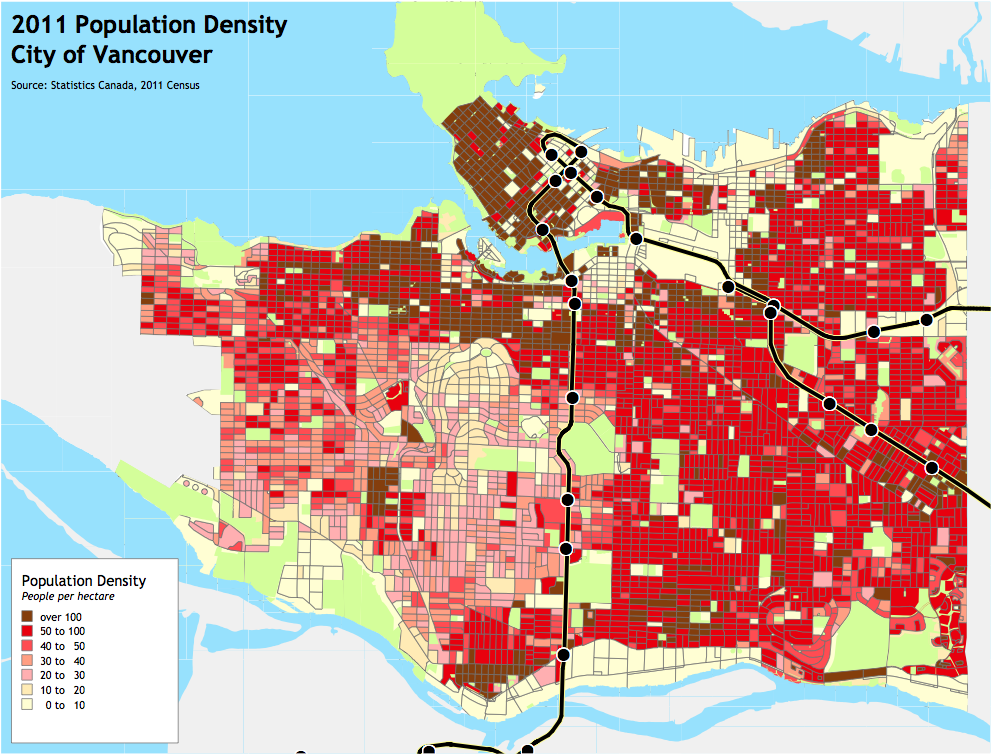
Another ignored aspect of affordable housing is where we build. Most of the push for densification is in areas of Vancouver that are already at the minimum densities considered to be “sustainable” communities. But this turns a blind eye to vast swathes of the city that are low density, single-family-home areas. Consider this map of density in Vancouver (full pdf here):
There is an interesting debate happening about what density should look like: towers vs mid-rise. I’m caricaturing a bit here, but check out Gordon Price’s case for towers, while Patrick Condon is more supportive of mid-rise. That’s an important conversation about how we envision our communities in the future, and the role density plays in ensuring where people are more able to walk and bike and take transit to work, shops, parks and public services. But it misses an important dimension: affordable housing has to be built into the fabric of how we design those communities.
What’s that look like? Inclusionary zoning is an approach that carves out a percentage of newly constructed unit as affordable. In a similar bent, we could waive parking space requirements, and trade density for affordable housing. More fundamentally, we need more purpose-built rental stock like we used to build from the 1960s to the 1980s. Housing cooperatives and community land trusts could lock in affordability on an ongoing basis. In our neoliberal times we also seem to have forgotten that the public sector can build new housing stock, too. Why not cut out developers, and their 25% profit margins on the sale of new units, in favour of a public housing development corporation?
Another ignored aspect of affordable housing is where we build. Most of the push for densification is in areas of Vancouver that are already at the minimum densities considered to be “sustainable” communities. But this turns a blind eye to vast swathes of the city that are low density, single-family-home areas. Consider this map of density in Vancouver (full pdf here):
.
.
There are large areas of town (the lighter coloured areas) that are super-low density, but that are walking and biking distance from downtown. It’s fair to expect some increase in density in East Vancouver near Skytrain stations. But how about rezoning Shaughnessy, where the average density is one-third that of Grandview-Woodlands (neighbourhood level data compiled here)? It’s not impossible — after all, Grandview was the original Shaughnessy, and still has many of those old mansions, now converted to smaller apartments, accompanied by lots of infill development.
At the end of the day, Vancouver is an attractive locale. People will continue to move here. But we are building lots of new supply, just not necessarily the right type of supply nor in the right places.





Shaughnessy was filled with rooming houses and affordable housing just a few decades ago but this ended with what appears to have been a unanimous political consensus. The systemic bias against purpose built rental is even deeper which has been covered by Dale McLanaghan in a report he produced several years ago.
Is the ever increasing intensification of residential land use in Vancouver supported by local employment? We can’t all work in offices and coffee shops. Are we building a bedroom city where residents will have to commute to the suburbs in order to find employment? Are we creating sprawl in reverse? Would Metro Vancouver residents be better off with a mixed land use system that would allow folks to live, work, and play in one place? Would we still need to build and expand mass transit in that case? Does Vancouver have to accept evermore growth? Why can’t growth be accommodated in undeveloped areas where best design practices can be applied? Why do we have to engage in a process of continuous deconstruction and reconstruction of our neighbourhoods? Why do our neighbourhoods need to be the focus of a construction economy? What is sustainable about our current city building practices? What is the best way to both build cities and protect the biosphere? And so forth, and so forth. Building the city is not just about density.
It seems like there is such a wonderful opportunity for compromise between the “no towers” crowd and the eco-density crowd. If your neighbourhood plan allows for multi-family units of up to, say, 5 or 6 stories then you can ban towers.
The map clearly shows that we can *easily* accommodate density without building up if neighbourhoods are willing to do their part.
Thank you for noting that very little housing is built on the West Side.
This is honestly the first time I’ve seen someone left-leaning acknowledge this as relevant to housing affordability – you’d think that “Wealthy homeowners are keeping the rest of us out!” would have more traction with the Mainlander/Tyee etc.
That said, no mention of filtering? The ageing towers of the West End and the ageing low-rises across the city are some of our most affordable rental stock (even the condos, which are often rented out by their owners). If you want more of those in 40 years time, building lots of new units now is the only way.
A few things to keep in mind here:
Density refers to persons per acre while crowding is the result of having too many persons per room. What drives crowding is inflated housing costs.
High rises increase density but they are expensive, costing roughly 3 times per square foot of dwelling when compared to low rise or walk up apartments. I have discussed supposedly affordable high rise housing in Vancouver with residents and even though the minimum wage in Vancouver is high, these apartments are still both small and very expensive, a perfect recipe for crowding and homelessness.
Realistically there are three situations in which high rise housing makes sense:
1. When access to scenic views drives up real estate values.
2. When proximity to work or cultural
Amenities drives up real estate values.
3. When scarcity of available land drives up real estate values.
Add to this the fact that point towers are the most expensive type of high rise to build – due to relatively more elevators per dwelling, and higher ratio of exterior wall space to floor space- and it should become obvious that point towers are not apt to be a viable low cost housing solution.
We still do see slab high rises used as low cost housing, but the problem here is that these are both expensive to build and expensive to maintain. For more information on this issue see the excellent film “the Pruitt Igue Myth,” which argues the the real source of this famous failure was the failure to fund ongoing building maintainence. Keep in mind that high rise maintainence is more costly than low rise maintainence.
Having studied the entire development of Vancouver in considerable detail, my opinion is that the solution to your housing problems could be found in a public private partnership that funds the construction of numerous mixed use midrise projects in locations that currently are commercial low rise properties. These would be easier and quicker to construct, enabling commercial streets to remain viable and they would not encounter the same degree of public opposition you’d like to encounter with high rises or projects attempted on residential streets. Plus this strategy would tend to make commercial streets both livelier and safer.
The originating article is simply goofy; define an immense, complex issue in a couple paragraphs, and come up with final solutions in a couple more. Just goofy. And using Shaughnessy as development area is part envy, part hate. Eliminate the development industry and have the public sector build new housing stock? Replace meaningful competiton in quality, cost savings of innovation, and taxable profit and replace that with a bloated, slothful union, monopolistic carelessness and eventual corruption. Brilliant.
Homebuilders are struggling to make the numbers work with high land, labour, material and municipal costs. New housing with modern building/enviro cannot be made cheaply. As Reilly points out above, filtering is ignored. If a small business needs a delivery vehicle, but can’t afford a new one (because they can’t be built cheap), there is an ample supply of used vehicles. We have a diminishing supply of used housing and much bidding for it. It’s astonishing developers are under attack and not landlords, who are being immensely enriched. The best location for redevelopment? Where buildings are obsolete.
Speaking of landlords, what would happen if government guaranteed 100% mortgages? This would mean for example that a young family without savings but gainfully employed could obtain a mortgage and own their own home in as little as 15 years. They could then adjust their lifestyle and explore new opportunities, making important contributions to society.
The house down payment is the barrier that condemns people to a lifetime of rent servitude. Upon retirement renters are still penniless and require government subsidy in various forms. Rent is an insidious form of usury, totally lacking in charity, and should be considered a crime against humanity hiding in plain view.
Public policy that supports 100% mortgages might very well invigorate the economy and reduce taxes at the end of the day.
They tried something like that in the states – but about six years ago they noticed some issues with it.
It led to some very affordable housing as far as I can tell.
PS
I don’t think that the issue was down payments.
Housing prices went way up. Affordable and financeable are not necessarily the same thing.
Details please
On the housing crisis?
Once more with further elaboration;
Speaking of landlords, what would happen if government guaranteed 100% mortgages? This would mean for example that a young family without savings but gainfully employed could obtain a mortgage and own their own home in as little as 15 years. They could then adjust their lifestyle and explore new opportunities, making important contributions to society.
The house down payment is the barrier that condemns people to a lifetime of rent servitude. Upon retirement renters are still penniless and require government subsidy in various forms. Rent is an insidious form of usury, totally lacking in charity, and should be considered a crime against humanity hiding in plain view.
Public policy that supports 100% mortgages might very well invigorate the economy and reduce taxes at the end of the day.
We should all stop wasting our time talking about densification; it is not an issue that touches our lives in a personal way it just affects our view of the neighbourhood. The real issue is tenancy because it can enslave people to a life of servitude. It affects how we build our cities, the form of development our buildings take, the places where we build, how we manage transportation, the character of our economy, and how we impact the environment. But most important of all rent is a destroyer of human potential, it affects how we work, why we work, and when we work. It affects how we think and what we think about.
We need to have a serious conversation about how we are treating each other; we all need to have the opportunity to become self-reliant members of society. We are not born slaves; we should not live like slaves.
So here are where I see some potential issues:
With the government guaranteeing mortgages lenders will be much more likely to make risky loans because of their potential for privatized gains and public losses.
People with bad credit and/or no savings, who are statistically at a higher risk of defaulting on their payments, will be much more likely to take out loans. Two issues with the no down payment scheme are that 1) Not being able to make a down payment indicates that the is very little wiggle room in your budget, hence the reason you have not accumulated any savings. This means that any changes that come about like having a kid, or losing a job, or maybe having the rate on an adjustable rate mortgage adjust could lead to you being unable to make your payments. 2) With no down payment you feel much less pressure to keep your expectations realistic so people will be more likely to decide on much more lavish homes.
As a builder you will feel less constrained to build more modest homes and charge more modest prices for the homes you are building. There will be a larger market for lavish homes and you will be able to generate the most profit on those.
Now you can do this all with the hope that it unlocks the human potential, invigorates the economy, and reduces taxes at the end of the day – but the problem is that if all that does not happen then the government has put itself in a precarious financial situation by using public money to guarantee a lot of loans that are bound to default. This should all sound familiar…
Also I don’t want to get you into the weeds with you too much but maybe comparing renting out rooms to slavery and other crimes against humanity isn’t giving those issues the weight they deserve.
Jeff O – and yet at least half of the households in major western cities are renters, and always have been, even in western European social-democratic societies. I certainly have rented for a number of years at various periods in my life and may yet do so again when I want to “cash out” (in the literal rather than figurative sense). To do so, I’d really like there to be a range of choices for ourselves, and to be fair, for all people who either must or prefer to rent, for a while or forever.
Hello Frank et al,
You it would appear have the luxury of either owning or “cashing out” and renting. There are many however who do not have this luxury for one reason or another. There are many who rent for lack of a down payment. This does not mean that they are poor financial risks and should not be given an opportunity to have a mortgage; after all they are already paying rent that in many cases is at least equivalent to a mortgage payment.
No-down-payment mortgages would still require a good credit rating and the normal income qualification along with a property appraisal. People would still have to deal with the ups and downs of life. However no matter how you look at it home owners are “invested” compared to renters who have nothing after a lifetime of renting. Renters do not get to “cash out” while homeowners can refinance, take out second mortgages and so forth.
I don’t think you should panic Frank about not being able to rent, that’s rather curious since you are living in a condo. Rentals will not disappear because there are no-down-payment mortgages, although rents might fall to reflect the fact that there are more options for people in the market place. I cannot think of a single renter who would be unhappy about reduced rents. And I cannot think of a better method to generate affordability.
The idea that housing prices will rise as a result of no-down-payment mortgages is not credible either because there is a finite number of qualified buyers at any one time and a limited supply of mortgage funds. People will always seek the best deal no matter which side of the equation they are on either buying or renting and the market will adjust accordingly.