

This post from kitsilano.ca is sure to generate response:
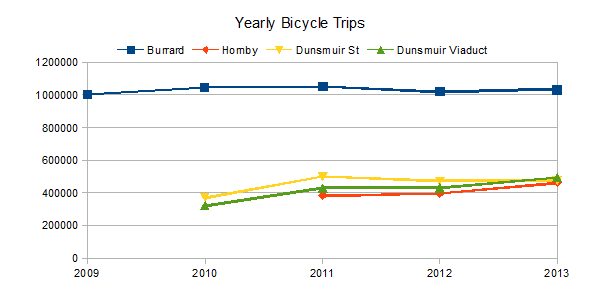
Vancouver has been putting in separated bike lanes since 2009. … The City of Vancouver monitors the bike traffic on the separated lanes, and makes this data available on its website. I’ve taken that data for each of the separated routes and put in into charts. [Go to site for charts on Burrard, Dunsmuir and Hornby.)
Although the data is incomplete in the years when the counts started, and data has been published only up to July 2013, based on patterns from the other years estimates can be made. You can see the year-to-year trends for each of the separated lanes below.
.
.
So after crunching all this data, you can see that over the past few years at least, cycling traffic in the separated lanes has been… well, pretty flat. …
The million-dollar question is, then: why are other cities seeing a huge increase in cycling, attributed to increases in bike lanes, when Vancouver isn’t? Is Vancouver moving too slowly in putting in bike lanes (it certainly is falling behind most other high-profile cities)? Have we yet to reach critical mass? Or is there some other reason?





Mandatory helmets!
Is it flat? We go from 1,000,000 trips in 2009, to 1,070,000 in 2010, to 1,130,000 in 2011, to maybe a bit less than 1,130,000 in 2012, to 1,150,000 in 2013. I see an increase, and just because last year (which had particularly poor weather) may have seen a decline, that doesn’t mean the overall trend isn’t an increase.
At some point, city officials are going to have to admit the province’s mandatory hard hat law is undermining all of the efforts and investments they are making in order to get more people on bicycles. And the sooner they do, the better. For what it’s worth, there are about 60 accidental drownings in BC every year. Can you imagine the effect a mandatory life jacket law would have on the city’s beaches and swimming pools? Sure, a couple of lives *might* be saved, but the level of users (and general public health) would unquestionably suffer.
For comparison: 60 drowning deaths per year versus an average of 8 cycling deaths per year since the helmet law (9 per year before).
The separated bike lanes in the graphic get you too few places. They get you into downtown, but usually not to the final destination or to transit stations like Waterfront or the Skytrain stations. Mostly you need to bike on busy roads for the last part of your trip. More separated lanes are needed before most people would consider biking in downtown.
The million-dollar question is, then: why are other cities seeing a huge increase in cycling, attributed to increases in bike lanes
The answer, is that that is a false causation.
huge increase in cycling is not due to bike lanes…
if so, Irvine, Ca should be a cycle mecca…
Noone should be cycling in Cambridge UK where there is virtually no separate bike lane, and still it is the cycle Mecca of he UK.
I am eagerly awaiting stats on cycling mode share in Toronto, but will be not surprised to see an increase in despite of Rob ford policy (removal of bike lane on Sherbourne…)
bike lane works only in some instance, like this one (typical parisian “bus/bike lane”):
http://voony.files.wordpress.com/2013/05/paris_ligne38.jpg?w=450
It is not the bike lane per sei (and all the BS about safety) who is encouraging cycling but the fact that you put in place infrastructure to make cycling faster/more convenient than other mode: That is mainly what achieve a successful bike lane, be in Paris, New York, and everywhere else…
When it makes driving more difficult, it work much better (and that is the root cause of cycling increase):
putting a bike lane where there is no car to displace is usually a waste of money, because it doesn’t help to make cycling a more efficient mode
Spending money on bike infrastructure and still requiring cyclist to wear an helmet is obviously also a waste of money
Some of your points are well taken, but the forced example of Cambridge is kind of silly. From a practical perspective, you can see Cambridge as being what happens when you make an entire town centre into a separated “bike lane” (plus a small number of VIPs, handicapped, and service vehicles).
I have my own theories, in addition to the helmet law, which is certainly going to be a drag on any growth.
1 – what’s the counterfactual. The data set for Burrard starts the same month the Canada Line opened. In addition to displacing people from cars, a major new piece of transit infrastructure can also be expected to move some people from cycling to transit.
2 – what’s the city-wide data look like? This is a pretty small view of cycling in Vancouver, and doesn’t tell us much beyond
3 – The data set starts when the lanes open, and doesn’t give us any idea to what the baseline usage was before the lanes went in.
4 – Network effects. People who are concerned about riding on roads really do need a network that takes them to their destination. Installing lanes only on two corridors without any last-mile infrastructure for other parts of the centre is only going to get you so far.
I understand that the percentage of trips by bike is already quite high for the downtown core and many times higher than the surrounding areas. From memory, downtown has 5-10x more trips by bike as compared to surrounding regions.
Could it be that the safety & comfort of the feeder routes may be the limiting factor, not the quality of the routes once riders reach downtown? Instead of looking at areas with high bike use, we should be looking at areas with very low (or average) bike use and asking how we can improve that.
It is good that effectiveness is being monitored.
I have not seen the improvements in Vancouver and wonder what has and is being done to improve safety for cyclists at intersections where the majority of crashes occur?
I agree with other comments about the need for complete/continuous routes to places people want to ride to.
Perhaps other cities are seeing a dramatic increase because they started from a relatively low starting point. New York, for example, was never a cycling paradise, quite the contrary. The infrastructure improvements certainly make that mode a desirable option now.
I’m only guessing, but perhaps Vancouver already had a fairly sizable biking culture. So, I’m agreeing with Ed above – ” the data set starts when the lanes open, and doesn’t give us any idea to what the baseline usage was before the lanes went in.”
It’s time people face the fact that Vancouver’s weather is going to put a cap on cycling. It has nothing to do with the helmet law, which is generally flouted anyway.
Copenhagen has far worse weather than Vancouver and has many times more cyclists. If there is a ceiling, we haven’t come close to hitting it.
Copenhagen does not have worse weather than Vancouver. Look up the average annual rainfall for both cities. Cold and wet is the worst combination for cycling.
Are you seriously going to contend that our weather & conditions are so obviously, severely worse than Copenhagen that they deserve to have 5x the rate of cycling and there is nothing we can do to get any higher?
I stand by my original comment – if there’s a ceiling, the other cities have shown that we are now where near hitting it.
Worse weather perhaps, but Copehagen and Amsterdam are a LOT flatter. Many conditions affect choice of mode – weather, culture and history, fuel prices, urban form, traffic, age – probably none more so than topography and geography, including urban geography.
With proper gears, the hills are quite easy to climb. E-bikes make hills disappear. Vancouver’s cycling mode share is a respectable 4% and growing. Rapid completion of a complete network will produce a rapid rise in cycling mode share.
Vancouver is a suburban city, similar to portland. Cycling trips will always mostly be commutes, and not utility trips unless people live downtown. Driving is simply too easy and convenient. The stats only show the separated lanes, while cycling across the city increased 40% in 3 years. The stats also don’t show the bump in cycling #s before and after the bike lanes. Vancouver has a few separated lanes, a few greenways, but it’s not enough.
In summary, Vancouver’s design doesn’t allow for a high cycle use other than downtown. Even with thousands of kilometres of bike connections all across the city, all trips other than to and from the CBD will be easier by car.
Further to your point, Kyle, I’d venture to guess that cities with with high and evenly spread densities – more like European cities and, say, San Francisco, Montreal and NYC – show a higher rate of bike(share) use than places like here which are so centre- focused with low density outlying areas.
Which brings me to a somewhat related point I haven’t seen discussed anywhere so far: that is that Vancouver’s bike share program intends to have 1500 bikes and 125 stations vs. NYC’s 6000 and 300. Put another way, 25% and 42% of the Big Apple’s program. And that it will only extend south as far as 12th Avenue. Does this seem overly ambitious to anyone else as it does to me?
Vancouver is one of the best places to ride a bike in Canada precisely BECAUSE of the weather. Hills can be a deterrent for some, but there will always be those willing to defy them. In any case, “hills and rain” are invoked by people who don’t typically ride a bike as determinant deterrents while people who cycle regularly get the necessary gear and practice getting better on the hills by going up and down them every day.
But am I taking the bike lanes downtown? Sure, once in a while, certainly not most of the time. Is that the only measure of cycling? It should not be.
Okay. Let’s extinguish the weather Argument once and for all! http://blogs.calgaryherald.com/2013/02/13/never-mind-the-plows-five-things-i-learned-from-the-worlds-most-bike-friendly-winter-city/
The fact is that if the culture is right, people will ride no matter what the weather. Of course, Vancouver’s bike mode share is definitely dependent on weather because it’s comprised of mainly sunny weather seawall sunday cyclists. And a few summer bike commuters.
BUT if we change the culture of cycling, then the weather won’t matter. The problem is that changing cycling culture is difficult. There are three things that will cause a change in cycling culture to happen: 1) Good city design (something that Vancouver dosen’t have other than the CBD (the scope of the proposed bikeshare)) 2) Good Bike Infrastructure (This one Vancouver has sufficient, but not enough. We need bicycle lifts for those hills!) 3) Political & societal acceptance of cycling. (this one vancouver does not have. cough*helmetlaw*cough*spandexcyclists*cough) 🙂
Sorry: are you saying that “spandex cyclists” indicate a lack of political and societal acceptance? And that the mandatory helmet law is indicative of this as well? And that anything other than to downtown core is “badly designed”? And that there are such things as “bicycle lifts” and that anyone would pay to have such things installed on Vancouver’s hills? And that the myriad of actions the City and the Province have implemented or are considering in terms of facilitating cycling amount to “non acceptance”? Fatuous claims, son, fatuous claims.
Regardless, growth in cycling usage here will continue to be incremental rather than explosive. IMO. I hope to be proven wrong.