
My current Business in Vancouver article:
The bets are in. The stakes are high. With billions on the table for the Canada Line and the Gateway project, we have two very different visions for our region.
The first, transit-oriented; the second, auto-dependent.
The City of Vancouver played its hand back in the early ’70s when it rejected freeways and said no to auto dominance. Instead, it made density livable. Transportation choices followed. The result has been called “Vancouverism,” and it is the face we will present to the world during the Olympics – the Vancouver of False Creek North, Coal Harbour, the Olympic Village, greenways, streetcars and sustainability.

The Gateway project, on the other hand, will spread auto dependence up the valley. The new bridges – Pitt River, Golden Ears and Port Mann – and their connecting arterials will lock another generation into a vision of Motordom from the 1950s: everyone drives and there’s always free parking.
 Call it ADUP: auto-dependent urban planning. The main problem with ADUP is that it drives out choice. It allows for only one mode of practical travel and limits urban design to a narrow range of options best typified by the strip mall.
To see a small but dramatic contrast between urbanism and auto-dependence, go to the new Aberdeen Station on the Canada Line. Descend from the platform and be irresistibly pulled forward along the landscaped greenway that curves towards Yaohan mall.

Here the pedestrian has priority, the overhead guideway provides protection and it feels safe and comfortable.
But when you get to Yaohan – no sidewalks!
 You You have no choice but to walk down the roadway originally designed when it was expected that everyone would drive and park.
So what’s likely to happen? Will pedestrians return to their cars to drive to Yaohan or will a new sidewalk be built to the mall? I’m betting “sidewalk.”
That small change will be indicative of the transformation that will occur up and down No. 3 Road as Richmond eventually  accommodates 120,000 people within walking distance of its five stations, a population equivalent to the build-out of Vancouver’s downtown peninsula. That’s the win from the $2 billion Canada Line bet: a city centre worthy of the name.
Meanwhile, out in Motordom, they’re building the strip malls and big boxes wherever an expanded interchange is anticipated or, in the case of Langley, already there. Even when plans for the 200th Street corridor call for “sustainable principles,” stand-alone commercial development will trump mixed-use when, as happened last month, developers make the case that auto-orientation is the only feasible alternative.

Advocates for Gateway argue that traffic congestion and transit options can be addressed simultaneously. Problem is, once we’ve built the bridges and widened the highways, who really needs the transit? Yes, the extra lane for additional buses may be provided, but more problematically, who will pay for the service? The message we’re getting from senior governments is that they will happily pay for big roads and bridges, but only for small pieces of rapid transit and nothing for operations.
We know from past experience how our billion-dollar gambles are  likely to play out. Rapid-transit will deliver on its investment by attracting growth to its stations, visible in the development that has sprung up along the SkyTrain lines and is already starting along the Canada Line.
We also know from experience that building more roads and  bridges will likely fail to solve the condition it was meant to address: traffic congestion. We have no model of success to point to in North America, no place where ADUP has produced the kind of urban environment that we want to be more like. The only place where vehicle traffic has dropped in our region is in the downtown peninsula, where transportation choices work.
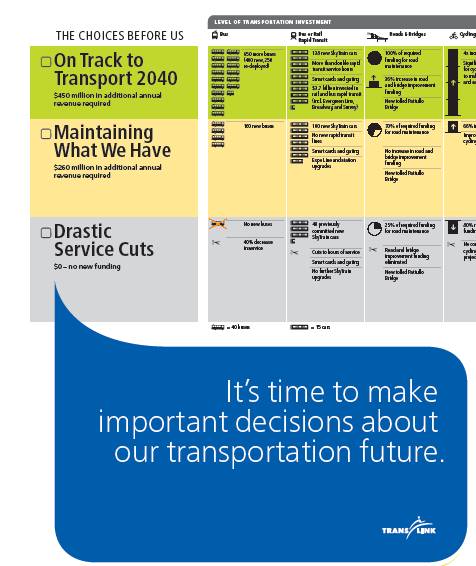
In the next few months, the provincial government will have to decide whether to support TransLink’s call for increased revenue. It’ll have to take another gamble. But given the near impossibility of supporting a new or increased tax for TransLink in this time of the HST, what are the chances? Will the Evergreen be delayed yet again while Gateway goes full-speed ahead? Will transit be cut just as the demand for it grows? The message couldn’t be clearer.
We may end up spending billions more on what we know will fail and starve success on what we know will work.
That’s just a bad bet. •





Great post Gordon. As you pointed out, Richmond has done a great job of the streetscape along #3 Road taking advantage of the guideway for rain protection.
Which is one more reason why Vancouver will remain a desirable place to live and the prices will remain high in comparison to the rest of the region. Watch Cambie flourish with the new Canadaline and future plans for the Oakridge area.
Getting in your car to pick up a jug of milk will never sway me to purchase anything out in the valley. Walking out my door a couple of blocks? Heck yeah!
Getting in my car to go shopping at a big box store? No way.
Getting on a skytrain to go to Best Buy or Canadian Tire on Cambie? Win!
Now if only Costco downtown would downsize their quantities to condo-size it would really be a big winner!
And most of my clients feel the same way.
The one thing I would love is one of those new urban ikeas to located downtown. They tend to only carry condo sized items, and they don’t have the giant warehouses attached to them, instead you order your items in the store and pick them up at a later date of have them delivered to you.
As much as I like Ikea I hate having to drive to the burbs to get to it (neither are really served by public transit).
Excellent post Gord.
I have thought for some time that the Storeum site in Gastown would be phenomenal for an urban-format Ikea.
well written, well illustrated and right to the point:
How come “Geater Vancouverite” can let it go (the gateway project)?
Some note: yaohan not only doesn’t have sidewalk, but it doesn’t have bike rack either!
bike and pedestrian access to nearby Canadian Tire, is a bit better, but not even close to the Aberdeen shopping mall which set a very good example of pedestrian mall development in the vicinity…
Even walking along this mall is interesting (more than along Sears blind bunker in downtown, though daisio doesn’t make really good effort to beautifulize its environment) and that is very important:
make a “feel safe” and enjoyable walk to transit.
Transit oriented development is great. The trouble is that low to middle income families are always neglected. A family with two kids with an average income would be doing well to afford a 850 sq foot condo in Vancouver, or Richmond even that is near transit with think walls and neighbours that complain about every single noise (kids make noise….condo developers don’t seem to realize or build for this).
So what is the family person to do? They end up going to the burbs where it is affordable. Too often, Vancouverites look at those in the burbs as morally inferior because they have to make a choice such as this. That is patently unfair and adds unnecessary distraction to this debate as stories like this inevitably bring around. Transit oriented development needs to become family friendly and priced at a level that the average family can afford without a 40 year mortgage (25 years is long enough thank you).
Seattle seems to have a much wider range of transit friendly housing options. Why is this? Near the LINK Columbia City Stn there are some intriguing new townhouse type developments built for families in a traditional city neighbourhood. Use of space is very efficient. Multiple family friendly townhomes are built in what used to be two or thee standard sized single family residential plots.
Why doesn’t the CoV encourage more stuff like this:
http://www.seattledreamhomes.com/PageManager/Default.aspx/PageID=2053003&NF=1
In Vancouver, the average family can choose from either a shoebox condo or nothing. You see some row homes on the West Side, but they just seem to be there to provide some stock under the $1 million mark. Still a long ways from being friendly for the average family.
Vancouver must provide choice for families. When that is done, the masses will see that transit oriented development is practical and can work. Not everyone can fit into a one bedroom condo. If Seattle can do it, why can’t Vancouver?
JJ,
It si not I want make advertising, but just show you can have something in the price vicinity of what you mention for Seattle, walking disatnce of the Canada line, http://www.stevestonrealestate.com/, and am pretty sure you can find cheaper along Millenium line in Burnaby toward or Expo in Surrey…
I think that was JJ’s point – you’ve just pointed to suburbia…
I suppose the question is why Vancouver hasn’t up-zoned the areas around Commercial & Broadway Station, Nanaimo Station and 29th Ave. Station from single family houses – to multi-family – maybe even townhouses? Because it would upset the NIMBYs.
The area around both 29th and Nanaimo is currently under review and will be upzoned in some fashion. But don’t think that the area isn’t already dense, pretty well every single house has at least one basement suite, a large portion have 2 (illegally of course). Broadway is another example of an area that looks undense but holds an incredible amount of people.
It’s always diffilcult to rezone a currently occupied area that is established, the reason Joyce was so easy is it was all light industrial.
I would definitely echo JJ’s comments.
There are examples of family friendly Transit Oriented Development in the Fraser Valley. Garrison Crossing in Chilliwack comes to mind, Morgan Crossing in South Surrey, and the Clayton Village in Surrey come to mind as well. The problem is that these may not be close to where you work. There are very few affordable options for a family with children within walking distance of the major light rail lines in Vancouver.
It’s good to remember that TOD’s can exist anywhere there’s transit, in suburbs or otherwise, and not just in Vancouver. There are plenty of urban, walkable, complete neighbourhoods that are accessible to workplaces in what we call suburbs such as Burnaby or Richmond, but don’t fit the classical definition of cul de sacs. Yes, CoV needs to work harder on this front absolutely, but I don’t think we should just dismiss projects in Richmond or Burnaby when they are in good locations, near transit, and are smart developments.
The Yaohan observations are interesting — attract Canada Line customers with signage and walkways then dump them on a driveway — when the first person gets hit by a car and sues the owner maybe they will build a sidewalk!
As for the Cambie corridor, I can’t wait to hear the wailing of all the NIMBY’s once zoning changes are proposed to densify the corridor. All the Canada Line station areas should have high rises with commercial at ground floor. As distances on Cambie and the station cross streets increases you could provide 7-6-5-4-3 storey developments decreasing in height with distance from the stations. Assume a walking distance to stations of 1km for densifying the area. Townhouse style ground floor units for larger families, condos above. Expensive, of course, its the West side, duh! I live in an 850sf condo downtown with a kid and its not so bad – lovely parks in the area, get out from your backyard, it will do you some good.
Maybe the NIMBY’s will quiet down once they realize their million dollar homes near the stations are worth 2 million due to the upzoning for developers.
I am not sure who’s the most persistent anti-Port Mann-Hwy 1 critic, Gordon Price, Stephen Rees, Bill Rees, Charlie Smith or Matt Burrows. Maybe there should be some kind of contest to determine who the ultimate Port Mann denouncer is?
I think JJ is onto the fact that pricing is the key issue here, as is stage of development in the outer suburbs. However, I think people such as JJ who plead with urbanists to recognize the price levels and affordability issues that they are fundamentally wasting their time. For the real purpose of the anti-suburb rhetoric is to establish in the public’s mind a product differentiation in favour of more urban residential real estate so as to support its higher price level.
Hey Gordon,
I completely agree with your argument. I have a lot of problems with the City of Vancouver’s backward and provincial attitudes on a lot of things, but this is one area where I’m a “true believer.” It really makes no sense to only use a “carrot” when it comes to transportation usage. We need to use other carrots like increased density around skytrain stations and sticks like tolls on existing bridges, increased gasoline taxes, vehicle levies and parking taxes. If the costs are relatively the same for transit and passenger car travel, those who can afford it will always choose the later because it’s “easier.” So if we can’t make the former easier and cheaper then it won’t truly be a success.
Further, DNA does more than just identify the source of the sample; it can place a known individual at a crime scene, in a home, or in a room where the suspect claimed not to have been. ,