

From Peter Ladner:
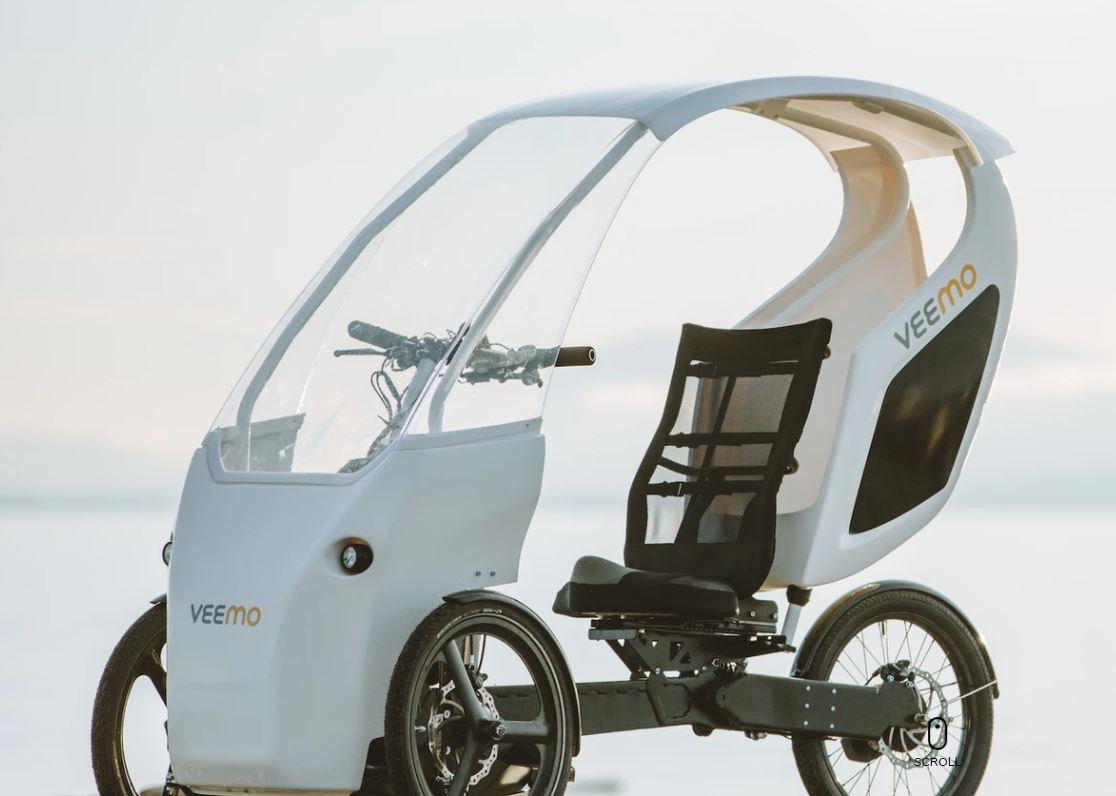 My son Brendan put me on to Horace Dediu. He’s a cycling advocate who has done pioneering math on actually reaching our targeted GHG reductions in transportation and discovered that even massive adoption of EVs won’t cut it. The unavoidable sweet spot is the burgeoning world of “micro-vehicles”– between skateboards, mechanical bikes, scooters and golf car(t)s. Vancouver-based Veemo (right) is just one example.
 Dediu, a Romanian-born Harvard MBA “known for his analysis of Apple’s business strategy and predictions of their financials,” applied his surgically-curious mathematical mind to transportation in this article, revealing the unheralded market for micromobility.
I would also highly recommend his drawn-out but utterly-mesmerizing-for-geeks podcast on How Micromobility Can Save the World. (Zen cyclists would appreciate Dediu’s seven-minute Youtube meditation on a Zen master’s answer to “why cycle?”)
Brendan (SmartWhistler.org) matched Dediu’s math. He worked out that even if EV adoption were ahead of predictions and all internal combustion-engine sales stopped by 2040, transportation emissions in Whistler would be higher than today due to the slow pace of automobile turnover, population growth, and EVs’ hidden GHGs.
Achieving Whistler’s, Metro Vancouver’s or B.C.’s GHG reduction targets in transportation is simply not going to happen without a massive conversion to micro-mobility modes of getting around.
Not enough people realize how much that is already happening. Horace tells all.
(Click title for full article by Dediu.)

Measuring the Market for Micromobility
The market for micromovilidad, micromobilidade, micromobilité, mikromobilität, micromobilitate, mikromobilita, микромобильность, μικροκινητικότητα, الدقيقة, マイクロモビリティhas never been better.
More people are riding more vehicles further and for more reasons than ever. With over 300 million electric bicycles in use in China, over 230 million two-wheelers in India, 72 million bicycles in Japan, 40 million in Brazil and over 100 million in the U.S., there are more microvehicles in use than there are cars. With electrification, connectivity, and software injections, these uncounted and largely unmeasured categories are gaining superpowers. It all happened so quickly.
The sheer number of form factors, the rapidity of development, the lack of registration or regulation, the variability of applications, business models, geographies, and infrastructures means that there is no single number for the “micromobility market.” No numbers for users, volumes, or value. No numbers for production, profit, or popularity.
That is not entirely a bad thing. Being uncounted usually means being unnoticed, and no competitive response means the small have more time to evolve. Flying under the radar, as the saying goes, gives you more time. But being invisible does not mean being unfelt. The perception of micromobilty is evident all around us.
In the cities, in the delivery services, the infrastructures, the agendas of planners, but most importantly, in the language. Pay attention to language, as it moves faster than data.
Take for example the word “scooter.” It can mean a kick scooter, a Vespa-like feet-forward motorbike, or a motorized wheelchair (in UK parlance). Or it can mean a shared tandem-wheeled electric board you stand on. People are appropriating the word to describe an activity that was not possible a few years ago: motorizing individual short-distance travel without having to pay for parking, insurance, fuel, or owning the vehicle.
Or look at “golf cart”—a misnomer as a cart cannot, by definition, be motorized, nor is it typically used on golf courses. Alternative names include neighborhood electric vehicle, rural cars, and low-speed electric vehicles. Millions are sold in China. More than electric cars.
Or take the humble rickshaw, human-powered, motorized, or electrified. Also known as auto, baby taxi, pigeon, bajaj, chand gari, lapa, tuk-tuk, Keke-napep, 3wheel, pragya, bao-bao, tukxi, tig or saqajamad. As of 2019, Bajaj Auto of Pune, India was the world’s largest auto rickshaw manufacturer, selling 780,000 units during the fiscal year. How many have heard of this manufacturer? Millions of these vehicles are sold each year and few are added up to any total.
When recalling the history of the car, note how much of that language came from French: garage, sedan, cabriolet, chauffeur, chassis, piston, grille, tonneau, limousine, coupé, convertible, and automobile. The reason is that France was the nursery of the car, the place where the technology was patented, developed, and shaped for its first 20 years (between the German invention and American mass production.) We don’t give much thought to how France made the car as we know it but we still use their words for it. The traces in the language tell us how things began.
Our mission at Micromobility Industries has always been to shine a light on this sub-auto world, the negative space in the graph of personal automobiles shown below.

This is why micromobility is defined not as what it is but what it isn’t. I chose a weight threshold because I knew what would not fit there, and in so doing, I knew how many other things would. It’s a “no-man’s land” but yet it is teeming with other species. You don’t need a telescope. If you choose to look with a microscope you can see entire new worlds.
Yet still, one feels that we should try to measure the scale and scope of this negative space. It deserves some inspection. This is my attempt to do so. This view is based on a bottom-up analysis of a few regions and a few vehicle types:

Note that the graph of micromoiblity is shown next to that of electric automobility. The so-called EV car market is perhaps overly optimistic in a projected 80 million units/yr in 14 years (up from 3.4 million last year) but I believe the micromobility market of 200 million units is conservative.
It’s a projection of data from Europe, China, the U.S., and some of India. It does not include one-wheelers or skateboards or hover boards. It does not include rickshaws or traditional motorcycles, many of which will be electrified.
The chart extrapolates from the data we do have: The growth in the European (EU) e-bike market. It takes into consideration the e-scooter and e-moped and some of the heavy micromobility (kei car and golf car[t]). It considers the electric two-wheeled market in India, which promises to grow rapidly through disruptive new entries.
It adds up to hundreds of millions of units of production. Over 1.2 billion in 15 years. Enough to supply mobility to a rapidly emerging, personally mobile, non-consuming middle class and an automobility over-served existing urban citizenry. And this is over a 15 year period: three automobile product cycles.
And yet, even with this, the answer to how big is the micromobility market is elusive. We don’t know the value. We can only guess at pricing and ownership models. We can only guess at utilization, sharing or replacement rates. And don’t even mention profitability. The question of the market size is perhaps best left unanswered. It’s going to be as big or as small as our imaginations.





I am continuously impressed with the performance of e-bikes. Either they are getting faster, or I am getting slower. Absolutely perfect for those who need a hill assist. All that needs to happen is an all-weather version for true cycling magic.
An idea I had as a kid was a separate regulatory regime for cars only used in sub 60kph environments. Since kinetic energy is the square of speed, there is great savings in the physical structure needed to protect passengers at lower speeds. A 500kg car is quite reasonable. Or course we would actually have to enforce speed limits.