
I 
There’s lots of discussion on what impacts Covid-19 will have on the way we will live in the coming months and years.
I have already written about Dr. Snow who was a Victorian era London physician. In 1854 he traced cholera, which was infecting and killing people in the Broad Street area of Soho London to a public water pump on the street.
By removing the handle of the pump, and asking patients to wash hands and practice good hygiene the infected water was not consumed and the cholera cases diminished.Dr. John Snow solidified the concept that health and planning were integrated, and this approach contributed to more sanitary housing conditions and safe water sources
The 1918 Spanish Flu epidemic infected 27 percent of the world’s population, but had a lesser death toll in New York City. What made the difference there was a “robust” and organized public health infrastructure, distancing of the healthy from the infected, a public health campaign and disease surveillance.
Today we are dealing with Covid-19, a virus which can be deadly and indiscriminately impacts the young, elderly and vulnerable. As we emerge from isolation there will be a new normal, and it will be markedly different. It is expected that some of the more vulnerable population will continue to self-isolate and physically distance by staying two meters apart. That population will use shops and services that offer the required distancing space, and spend more time at their home abode.
The pandemic has also shown that sidewalks for walkers and rollers are not built wide enough to offer the required two meter physical distancing space. In Canada, Winnipeg and Calgary have responded by closing off streets to allow people to exercise and get to shops and services by walking or rolling on city streets. Vancouver’s Park Board took the initiative to close the road in Stanley Park for walkers and cyclists. Besides a section of Beach Avenue, Vancouver has not dedicated a connected series of streets for walking, rolling or biking off the downtown peninsula.
New York City has just announced that 40 miles (64 km) of connected street would be available for walking, rolling and cycling, and wider sidewalks and wider bike lanes built on other streets. Mayor de Blasio intends to open 100 miles (160 km) of city streets during the epidemic. This is a huge change in the Mayor’s thinking but as he stated “social distancing on the city’s narrow sidewalks and in its parks will only become more difficult as New Yorkers flee their cramped apartments during the warmer months seeking fresh air and sunshine.”
Lloyd Alter in Tree Hugger sums up the fact that we need a rethink of how we do domicile density and what amount of the public realm we give to walkers, rollers and cyclists. He challenges the concept of “density done well” from a physical design perspective, suggesting a more holistic approach in “Density Done Right”.
As Lloyd remarks, it has “become clear is that being in lockdown in high-density towers is a pretty awful experience, whether it is the lack of space or the shared elevators or the crowded sidewalks.”
“Density done right” or “distributed density” is a term used in the Ryerson City Building Institute’s study which found that high rise development put demands on “transit, water, wastewater, parks, childcare and schools”.
Density does not appear to make housing cheaper, forcing citizens to choose between crammed condos or commutes from outside the city. In high rises, elevator virus protocols need to be transparent about how many occupants can ride at the same time, and halls need to be designed to allow for physical distancing. Exterior corridors could mitigate some of these issues.
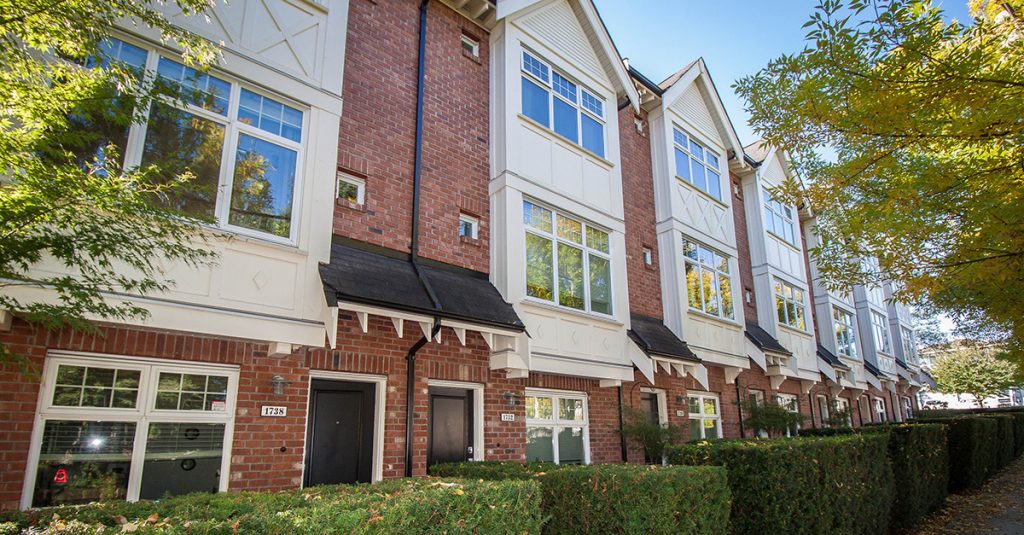
Lloyd Alter is a proponent of “gentle density” walk-ups and townhouses which can provide front or rear yards, and ground level entry. He calls this “Goldilocks” density in that it is not too tall or not too sprawl, and focuses on being walkable. But in a time of self-quarantine and self-reliance, the access to greenery, private space, light and air takes on a premium, and a rethink of how we define livable space during a pandemic and through more “normal” times.
Central to this discussion is also the need for transit, and the location of jobs. This YouTube video below from Ryerson’s City Building Institute explores these topics more fully in this discussion recorded earlier this month with Toronto’s Ken Greenberg, Murtaza Haider and Cherise Burda.
Images: CBC.ca & City of Vancouver





Given that cities will become much less interesting (no large events, sports, culture) and teh decline of street life, it is going to be hard to justify putting up wth the high prices, crime etc. There will be fewer restaurants, interesting little shops etc.
“THE FLATTENING OF THE AMERICAN CITY
The growth of online shopping and big business will be hard to ignore for many city residents. It will make cities feel more desolate and less singular, for the next year or longer.
As e-commerce grows, it will pull more stores out of ground-floor retail locations. Many of these spaces will stay empty for months, removing the bright awnings, cheeky signs, and crowded windows that were the face of their neighborhood. Long stretches of cities will feel facelessly anonymous. With fewer independent stores and more Americans working from home, the streets will be quieter, too. Some urban residents might enjoy the feeling of a half-filled city; it will carry the eerie vibe of an awkward, permanent holiday. But even those cheered by the ample sidewalk room will find, in the darkened windows to their left and right, a shadow of the city they knew before the plague…”
https://www.theatlantic.com/ideas/archive/2020/04/how-pandemic-will-change-face-retail/610738/
Given that…?
What makes you think “that” is a given? Cities have been growing bigger and denser for thousands of years. We’ve had pandemics and other calamities in the past and yet cities just kept growing bigger and denser. We’ve heard thousands of city-haters spewing nonsense about how terrible cities are and yet they keep getting bigger and denser.
We’ve had a relatively brief few decades of of car oriented sprawl that is turning out to be equally vulnerable to this pandemic but is responsible for massive increases in energy use, waste and climate changing greenhouse gas emissions. But the popularity of dense cities is returning, continuing a trend that began long before ancient Rome, Greece or Egypt. Every time there were major societal setbacks, the recovery largely came in the form of growing and dynamic new or rebuilt cities.
It remains to be seen how much e-commerce will grow and challenge the economics of bricks and mortar in real cities, towns and villages. There may well be a natural maximum where convenience gives way to boredom and isolation and a need to get out and off the screen. Maybe it will remain popular with those who shun other people and hide away in their secure little castles, but getting out and being social is much of what makes cities attractive in the first place. And cities are attractive enough to suffer from continuous high costs – a sure sign of demand.
Unfortunately many businesses will not survive this crisis and it will likely take years to recover. That there are so many businesses to fail is a strong indication of just how much we make use of them.
It’s just a bit much to start with, “given that”, when there is no “that.”
Bob, since it’s clear you really really hate cities, perhaps you could explain to all of us what your preferred options for housing and employing and transporting 8 billion people would be. You must have really thought about this and have some great ideas to be so sure that cities are just plain wrong.
It seems to me this is an excellent forum for such a discussion. Let’s hear what you have to offer besides relentless criticism of something you just don’t like.