

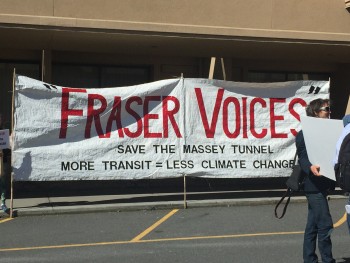
Well, where would that be? If you are Minister Todd Stone and you are writing a letter to The Richmond News published October 25 in response to the potential twinning of the Massey Tunnel under the Fraser River, it IS the Massey Tunnel.
Answering a query to the 2006 Gateway Program Definition Report that identified a longer-term plan to twin the George Massey Tunnel, Minister Stone responds: “Twinning the tunnel in this context was not an endorsement of the construction of a new tunnel, but rather the report promoted the need to increase the capacity of this vital crossing.”
“There is no doubt amongst anyone who must pass through the current tunnel that a change is necessary. The George Massey Tunnel represents the single worst bottleneck in the province. Over the last 10 years, the ministry has engaged in detailed technical analysis and broad consultation on a number of options that will ensure the smoother movements of people and goods along this important corridor.”
And here is the best part of the letter: “The new bridge will be 10 lanes wide, benefitting both drivers and transit users with increased reliability and reduced transit travel time. The new bridge design includes dedicated transit/HOV lanes to ensure reliable transit service, and will be built to accommodate future rapid transit service. It will also have added access for cyclists and pedestrians. This free-flowing bridge is expected to reduce GHGs by about 13,000 tonnes a year, a 70 per cent reduction from current conditions at the tunnel, and save most commuters 30 minutes a day.”
Now that is news to me that pedestrians will be walking across the proposed Massey Bridge. I don’t know where they will be walking to or from. I expect the tonnes of GHG reduction must be from the Province’s estimation of vehicles idling, which of course could also be solved by tunnel twinning. And of course free-flowing refers to traffic ON the bridge, not the bottlenecks that will occur off the bridge.
Not only does Minister Stone say that a new tunnel would be more expensive than a bridge, he notes a tunnel “ also carry significantly more construction risks and would have a greater impact on the environment, private property, agricultural land, and the Fraser River. The George Massey Tunnel Replacement Project is subject to British Columbia’s world class environmental assessment process that incorporates the feedback from several federal agencies, including the Canadian Environment Assessment Agency, Environment and Climate Change Canada and Transport Canada, into their final decision. And let me be clear — there are no plans to dredge the Fraser River.”
Minister Stone notes that the new bridge will survive a one in 2,475 seismic earthquake event, and that public feedback on the project has been “instrumental” and the project “will continue to incorporate local advice”.
The full statement can be read here.





The BC Liberals claims that every urban road expansion project will reduce climate pollution are just BS. The federal government and others have called them out on their lies in the past, but to little effect (because there has been little media coverage). But the tide has turned on climate denial, It is no longer so acceptable to deny the facts about what increases and decreases climate pollution. It is time to call BS on the BC Liberals misinformation campaign.
True that.
The “Ten Myths” piece published by the MoTI regarding Massey is a pure, bald-faced propaganda piece. The writers couldn’t possibly pull that one off with a straight face.
I’m reminded of the documentary where Enron staff were recorded laughing and ridiculing citizens behind their backs as they flipped switches to black out portions of California in order to “rescue” them by selling supplemental power at outrageous prices.
The “reduction” in emissions claim by replacing a 4-laner with a 10-laner + 20-laner is also an outrageous junior high-level piece of hubris that is immediately kyboshed by the words “induced demand.”
If for nothing else we owe it to our First Nations to provide them with properly functioning modern infrastructure, so they too can fully participate in the growing economy of the region. The Tsawwassen First Nation is leading the way that we all need in the resolution of of agreements that integrate these nations into our society as full partners.
“Tsawwassen First Nation is very supportive of the plan to replace the George Massey Tunnel,” Chief Bryce Williams said. “Tsawwassen First Nation is building a sustainable and vibrant economic future – one that is integrated with the rest of the region. Travel times to shop, to work, or to live on Tsawwassen Lands depend largely on replacing the aging tunnel with a bridge designed to handle current and future growth in our corner of the Lower Mainland.”
– See more at: http://www.delta-optimist.com/news/tfn-adds-support-to-tunnel-replacement-project-1.2220158#sthash.l3vgR2XN.dpuf
The Tsawwassen First Nation support is not acknowledgement that Massey and the auto-dependent development it is fostering are not widely discredited models of planning, and another step toward failure to realize Canada’s climate obligations.
Three other local First nations are supporting much different and more sustainable models of planning and development where transit, urbanism and lower per capita emissions are the antithesis of what the Tsawwassen are supporting.
There are much more beneficial tenets of modern, 21st Century treaties with our indigenous people that can be brought forward. However, with the exception of four Metro FNs, the treaty process has been purposely slowed down by a shamefully obstructive province. The key impetus with the four Metro FNs is an urgency about urban development, and the direct involvement of the federal government.
“… are widely discredited models …”
Any attempt to divide the decisions and sympathies of one First Nation against those of other First Nations might not be the gentlemanly thing to do.
It is naïve to assume that there are no differences between FNs. It is not divisive to point that out.
Like other folks in (real) nations, FN don’t always share the same view on cars either. Some like density, some like urban sprawl like Tsawwassen Mall and some like no development at all.
I have to agree about the worst bottleneck part. The solution: not so much.
I’d say Lionsgate bridge is the worst bottleneck, followed by Second Narrows and Broadway corridor, and also Hwy 1 east of Surrey before Abbotsford. Massey is certainly in top 5.
Does NOT matter which is the worst bottleneck. The problem is that they are FREE. Toll existing crossings ( HOV ) exempt). Why subsidize another money loosing bridge to induce traffic.jams elsewhere. Revenue could be used to to pay the principal & interest on the subsidized Port Mann. & Golden Ears.
So here’s my gripe…
If you want to claim that additional traffic won’t utilise the new bridge is true due to the tolls, then a new bridge reducing travel time will reduce congestion and pollution. The bridge will be a money loser though.
If you want to claim that the bridge will be well utilised, then it likely won’t be a money loser, but pollution may temporarily increase; at least until the generally falling per capita impact of vehicles catches up to the volume increase.
You can’t argue it both ways at the same time.
Port Mann is starting to see some fairly large usage increases though, so it might not be the case that the traffic studies were as ridiculous as initially thought.
Good points.
If traffic and pollution does decrease then anyone interested in the environment will certainly consider it money well spent.
There’s quite a bit more to the equation than simply the traffic/pollution at the bridge itself. The notion that the bridge will reduce pollution by reducing idling in the short term is so incredibly short sighted and naive, it’s hard to believe they can even say it with a straight face.
It happened on the Port Mann, so there’s every reasonable and experienced consideration that it will happen again. “Peer Reviewed” by the Port Mann, so to speak.
Although, relieving any bottleneck to improve flow is a universal fact for anyone that understands the flow of anything in universe.
Eric, the bottleneck at the Port Mann may be gone, but what about the increased traffic on the IWMB, Upper Levels, Grandview and other exit points. A wider bridge does not make traffic disappear it increases traffic and increases congestion further down the highway. That is why they are spending more to upsize the Lynn interchange which will simply encourage more car traffic which will simply create more congestion. The only way to end this – and even cities like Atlanta and LA are finally understanding this – is through increases in transit and cycling. And even smarter cities are fixing congestion by also adding road pricing. Unfortunately, we still have a car first policy which creates such a hole in our transportation budget that there is little left for real solutions.
You can also remove traffic bottlenecks and improve the flow if you put the money into viable transit alternatives and getting cars off the road. It’s even cheaper than giving most of the taxpayer’s money to the totalitarian regime called Autotopia.
Proper and suitable roadways are always needed and are essential in any developed society. Trains are good too.
I agree. But we are getting swamped by completely improper and unsuitable roadway projects and not enough trains.
When you provide the space into which traffic can increase, it will increase as long as drivers can afford to drive. Increasing the real estate devoted to cars with huge highway projects affects the entire region in many ways (induced traffic, public finances, pollution, land use, etc.). That is the crucial point to be made here.
The southern suburbs will grow, fast, whether or not a new bridge is built. It is incumbent on the province to provide suitable roadways to these regions.
They will grow in quite different ways depending on what transportation options they are given.
More roads creates more sprawl which demands more roads….
Great transit encourages walkable neighbourhoods and less traffic.
But you don’t want to know this. It doesn’t fit your road fetish.
Neither the population growth or anticipated commercial traffic will justify such overblown traffic infrastructure. The “solution” is unsuitable to the circumstances.
Author
Reblogged this on Sandy James Planner.
Eric,
What happened on the Port Mann? Reduced idling?
Generally, yes. I’ve yet to be stuck in traffic since the bridge completed when I use it which is generally off hours. The next bottleneck is the section of Hwy 1 from Langley to Abbotsford, which probably affects fairly small portion of bridge users.
On the old PMB, I remember being stuck in a queue at 11PM on a Saturday night heading into the city after coming back from Seattle.
My partner also now drives that route counterflow every day. 35 minutes from East Van to Langley.
Talk to me about traffic on the PMB in 10 years. Two years after opening is not a long enough period to draw conclusions about the long term effects on the region of a massive increase in available space for primarily SOVs. Remember, the justification for the public debt for the PMB and all associated freeway work was for commercial trucks. My bet is that one who actually analyzes the traffic will find the number of SOVs remained the same as the pre PMB 70%, or even increased.
Much of the idling has moved to the Pattullo and Alex Fraser bridges.
Much of the idling has moved to the the Pattullo & Alex Fraser because they are FREE
Reduced idling – reduced pollution. It seems quite easy to comprehend.
More vehicles, more pollution. Even easier to comprehend.
So if you are planning on tolling resulting in reduced traffic, as you noted above, why would you be in favour of spending billions? You wouldn’t need a new bridge. Just put the tolls on. Make it revenue neutral, so it isn’t a money grab.
“Extrapolation”, Jeff. Is that a Carly Simon song?
As we all know Jeff, even Justin Trudeau believes strongly in infrastructure spending and that’s exactly what he’s going to do.
Not on Massey, much to Christy’s chagrin. She probably thought the song was about her.
Don’t know about “extrapolation”, but there was one called “You’re so vain” IIRC
Were the points raised too difficult to respond to?
As long as Metro and TransLink concentrate on not building a rail rapid transit system we can be certain that there will be more traffic. The massive increase in vehicle sales and the tiny increase in TransLink customers confirm this.
The rest is fantasy.
Transit, by design, is reliant on senior government funding. Junior government funding cannot do it all because senior governments take 90% of the tax revenue generated by the Metro. That’s the point you always ignore in your incessant trolling against local government.
I’m quite sure we read the transit referendum documents very carefully and it read that it was based on the Mayors’ Plan which was signed by a Tamin Raad, Director, Strategic Planning and Policy, TransLink, stating that the plan was to extend the Millennium SkyTrain Line from VCC to Arbutus and a new light rail line into Surrey.
The provincial government is not mentioned anywhere in the document. It was TransLink and Metro that devised the failed plan.
Oh yes, the plebiscite imposed by the premier on only the Metro, and a plan that was heavily loaded with transit? The plebiscite questions edited by the provincial government? The plebiscite that failed at the feet of TransLink, an entity heavily manipulated by the province? The plebiscite that followed a provincial audit of TransLink that found little to complain about?
Maybe we should add an 11th Myth to the MoTI’s Ten Myths.
A toll would help but with 1M more people we need more infrastructure, both public transit and roads.
4 dislikes = 4 people with their head in the sand. More people with the same old decrepit infrastructure makes no sense. People, and associated goods in a growing country with Vancouver as its only major Pacific port needs MORE infrastructure, both public transit as well as roads/bridges/tunnels. What is so difficult to understand here ?
Canada is on route to 100,000,000 people by 2100 i.e. around 10M in the Lower Mainland. We believe we can do that by adding a few buses, a few bike lanes and a few seabuses ONLY ?
Perhaps they simply find your arguments lacking in logic?
More transit, many will agree IMO.
Roads kept in a good state of repair (not decrepit), many will agree, IMO
More roads as a solution, many disagree. It has been shown to not be a solution. I suspect more roads is the point people were voting down.
Make that 6 and counting Thomas.
You only need to sit in that ridiculous congestion on occasion to see that more roads don’t work. Those who do it regularly can’t see that. They are part of the problem and who wants to admit that?
Look around in those traffic jams. Lots of SOVs holding up all those important trucks. A few of them might not have a choice.
Most choose it.
Yup, just like socialism where some politicians edicted that paying everybody the same is a good idea, which it is – in theory.
The issue is the disconnect to ordinary people not blogging here. Ask yourself, why was the transit referendum voted down and why have the “great” NDP ideas of more debt, higher taxes and more public transit not resonated with the electorate ?
The transit plebiscite was not voted down because people didn’t want better transit. It failed because of a simplistic message that we could fund way more transit if we just fired a few over-paid managers. There was no basis in reality.
The ideas of the NDP often don’t resonate because they are based more closely on reality and who wants to hear that? Fairy tales and scapegoats! That’s what wins elections in BC. The Liberals are masters.
Ah. That’s why TransLink fired its own boss just before the vote. TransLink didn’t understand reality. Thanks!
“CBC: It’s a sad comment on the state of executive compensation that most Canadians can only dream of being a failed CEO.
Either you get fired with full salary for a year or more, or — like Vancouver’s former TransLink head Ian Jarvis — the same board of directors that found you lacking keeps you on as an “adviser” at roughly 10 times the national salary.
In a hastily arranged news conference, the board announced it would be removing Jarvis as head of Metro Vancouver’s beleaguered transit authority to “restore public confidence” on Wednesday.
“Heads you win and tails you win,” said Concordia business professor Michel Magnan.”
Firing Jarvis was a dumb desperate move. Do we agree?
In the absence of any internal corporate facts at my disposal I can’t say whether it was dumb or otherwise. I would agree it seemed desperate.
I look forward to the day we can see the minutes and know who proposed the motion to dismiss him.
Oh oh. It’s up to 10 now, and counting. More transit and less roads please!
@MAB: yes to more RAPID transit but also yes too more/wider tunnels/bridges/roads were we have severe bottlenecks today. In other words, no to the transit referendum Mickey Mouse plan for basically only more bikelanes, more buses and a Broadway line to Arbutus only, with 0 increased property taxes and 0 increase in parking fees for parking in residential streets. Not bold enough. Too timid. Hence: it failed as it was a poor plan.
In the absence of any more rapid transit people that do not like tall highrises vote with their feet (aka car) and move to the suburbs.
More buses a little rail spur to Arbutus and one more Sea Bus. How exciting! No wonder everyone went woozy. Seattle went for $54 US billion for their transit referendum.
It’s like TransLink were pan handling for a dime.
“Reduced idling – reduced pollution. It seems quite easy to comprehend”
In the short term. Short term. Why is that your only narrow perspective.
If you want to use environmental rationale for justifying this bridge then you have got to look short and long term at all the issues. Your myopic perspective serves nothing but supporting your own pre-existing beliefs.
There can be no question that the construction of another, or expansion of the existing, tunnel instead of a new bridge would be far, far more disruptive to the environment. Farmland on both sides of the river would have to be taken and used for the connections to all the existing roads. Were a new tunnel to also have sufficient capacity for a rapid transit line and bike and pedestrian capabilities, as the new bridge will have, then we would have to consider a very large and comprehensive new second tunnel.
Eric,
You’re missing/ignoring my point. So it goes.
Imagine … keeping the tunnel. Building a 2-lane rail transit bridge. Requiring a corresponding transit-based urban planning response in all communities linked by rail.
It’s easy if you try.
@Don, I’m not at all ignoring your point regarding the environment.
Long term, sure build a rail link. Is anyone at Metro Vancouver or TransLink discussing this? Anyone? Has anyone ever mentioned it?
Where would the rail go? Steveston Highway, Ladner, South Delta, Tsawwassen and the ferry terminal, is the obvious first step. That’s 24km, about the same distance as Waterfront to Port Moody, or Waterfront to Lions Bay.
The province is calling for the design of the new Deas Bridge to be able to support rail, it’s up to TransLink and the GVRD to decide they want to build it.
I don’t see how a tunnel is worse than a bridge from an environmental perspective. A second tunnel would have minimal impact. What will have a huge impact with a bridge and associated port expansion is the dredging of the river and the expansion of Surrey Port, the building of an airplane fuel terminal and the building of an LNG plant.
Eric,
No, it’s up to the Province. You and I are going to pay for it one way or the other, it’s up to the Province to determine how. They determine if the bridge is going in, the new SFPR, new Hwy 1 widening, etc. They determine what skytrain gets built where and when.
Don’t delude yourself in thinking translink has any real say in it. They can talk and talk but at the end of the day the Province decides how the money is going to get to translink and on what they’re going to spend it on.
Of course, they blame translink cause it’s politically expedient and easy, so that arrangement isn’t going to change with this government.
Regardless, my point re: environment is not just the bridge itself, it’s the sprawl it enables and the myriad of environmental issues that brings, the long term increase in pollution with cars on it, the decrease in agricultural land, etc etc.
Now I know you believe that sprawl in the valley is happening regardless of the bridge, but then that goes counter to your continually made point that building a bridge won’t result in increased traffic (ie induced demand). I don’t expect you to square that circle, so don’t bother.
Quite right, Don. Let’s hope that TransLink is listening.
Maybe you’re on to something. Perhaps the building of all the new homes in Delta, Surrey and Langley will soon stop because even if a new bridge is built because it will soon fill up due to ‘induced demand’, then people will just stop building out in the sticks because the roads are too damn busy.
By the way, why has anyone been buying out there all this time if the tunnel is so busy? Not enough condos downtown?
Right, like I said, don’t bother.
Don’t be coy, Don. Why is South of Fraser booming?
Not sure if you noticed but last night Gil Kelly, the new and improved Vancouver City Manager said that Vancouver needs more mid range homes, specifically, townhouses and duplexes. Exactly what is selling like crazy in Delta, Surrey and Langley.
Blame it on the bridge.
No Eric, Blame it on the lack of townhouses in Vancouver.
I agree. I’ve been saying this for years.