



Article Categories
Archives (2003-13)
Recent Articles


Recent Episodes


- Podcast
- Events
- Support
- About Viewpoint Vancouver
- City Elections 2022
- Climate Change
- COVID Place making
- The Livable Region
- Transportation
- Urbanism
- All The Livable Region
- Business & Economy
- Energy & Resources
- Governance & Politics
- Housing
- All Transportation
- Cycling
- Infrastructure
- Motordom
- Public Transit
- Walking & Mobility
- All Urbanism
- Architecture
- Art & Culture
- Design & Development
- History & Heritage
- Policy & Planning
- Nature & Public Spaces
- Podcast
- Events
- Support
- About Viewpoint Vancouver
- City Elections 2022
- Climate Change
- COVID Place making
- The Livable Region
- Transportation
- Urbanism
- All The Livable Region
- Business & Economy
- Energy & Resources
- Governance & Politics
- Housing
- All Transportation
- Cycling
- Infrastructure
- Motordom
- Public Transit
- Walking & Mobility
- All Urbanism
- Architecture
- Art & Culture
- Design & Development
- History & Heritage
- Policy & Planning
- Nature & Public Spaces
Lovely, Sandra. I’ve heard this ivy story before but you made it come alive.
Slight correction. She was not “a Canadian who moved to New York City.” She was an American, born in Pennsylvania, who moved to Canada in 1968. But, yes, we can proudly claim her as ours!
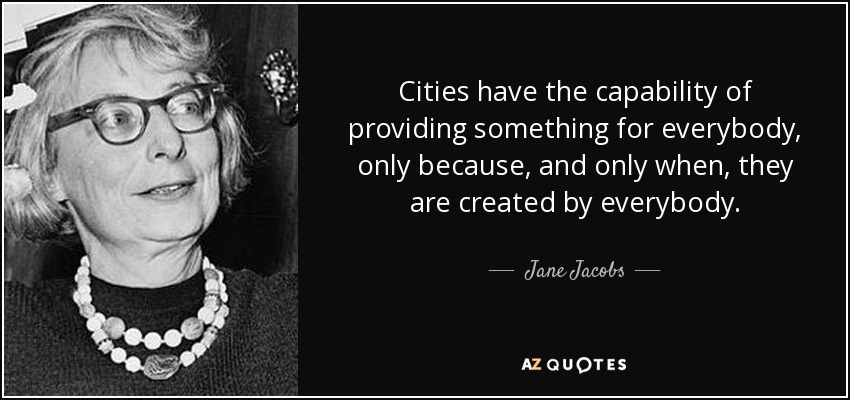
We weren’t sure when we were cycling in Toronto 2 years ago, when we saw this permanent like mural quote by Jane Jacobs, her home city:
https://cyclewriteblog.files.wordpress.com/2014/05/janejacobs.jpg
It’s near Casa Loma just north of Spadina Rd. and Bloor St.
I remember reading a Vancouver Sun article years back that featured a photo of Jane sitting on a bench on the North False Creek seawall with a backdrop of Concorde’s high rise towers. The article was based on an interview where she distinctly praised Vancouver for fostering a dense residential community in downtown, and for opening up the waterfront to public access.
Jacobs has been referenced time and again in anti-tower tirades, but I believe such critics demean her intelligent insights on the humanity that cities contain, and her promotion of walkable, mixed use neighbourhoods and human-scaled streets and building edges filled with neighbourhood amenities no matter what form the buildings above take.