

Here’s a map that reveals a side of Germany you hardly ever hear about: shrinking cities – and there are a lot of them.
.
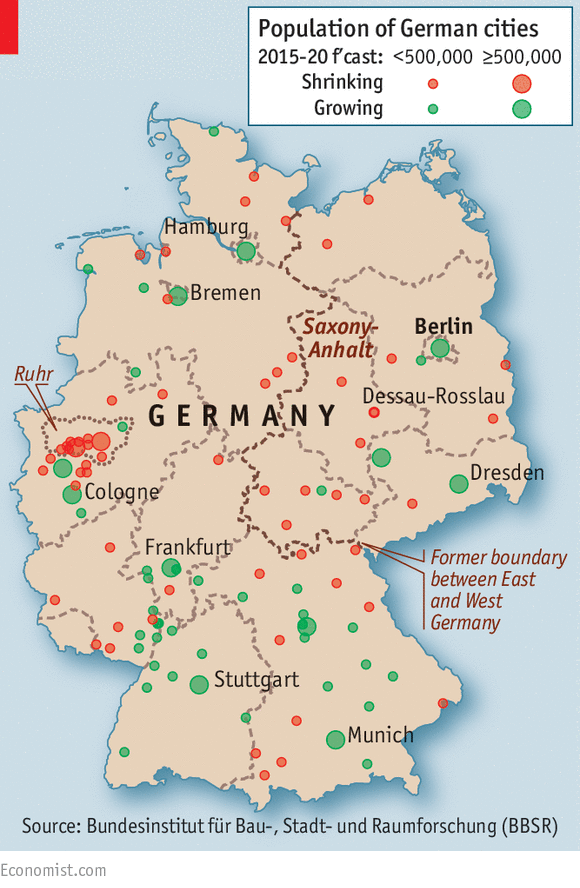
.
It’s part of article in The Economist – “Rus in urbe redux” – linked by Sandy James.
From 1950 to 1955 only ten of the world’s largest conurbations lost people, according to the UN (see chart). The tally rose steadily over the next few decades, before jumping in the 1990s, as the collapse of communism in eastern Europe and Russia was followed by a colossal migration.
Today just over 100 conurbations are losing people. But this greatly understates the scale of urban decline. In many countries, big cities with diversified economies are growing at the expense of cities too small to make the UN’s list. Germany has 107 autonomous cities, of which 60 are expected to contract over the next five years. But almost all of the biggest cities will escape decline (see map).
Full article here.





I’m surprised to see Wolfsburg on this map in the shrinking column – as it’s the headquarters of VW, I know it’s growing now, but maybe they know something we don’t. I’m also surprised to see Hannover…doesn’t seem to be on the map?
Still, this vision is pretty striking. I’d be surprised if a similar map for Canada returned similar results, though, I would be really curious to see it.
Indeed. My aunt just died in Braunlage, Harz, near the former east-west German border in former W-Germany. Condos of 80 sqm (roughly 900 sq ft) can be had for 30-45,000 Euros.
Nothing going on. Dead dead dead. No jobs. No subsidies, as those went to former east-german towns. Whereas Munich, Berlin, Duesseldorf, Hamburg are booming. Similar to Canada.
http://www.welt.de/finanzen/immobilien/article134098731/Hier-wohnt-Deutschland-noch-ganz-billig.html
http://www.welt.de/finanzen/immobilien/article13946607/Immobilienrausch-zieht-Deutsche-in-Spekulationsfalle.html
Just looked at the underlying report http://www.bbsr.bund.de/BBSR/DE/Veroeffentlichungen/AnalysenKompakt/2015/DL_01_2015.pdf?__blob=publicationFile&v=3
which gives a much finer analysis.
Bottom line for most cities across Germany: Inner city areas are growing, suburban areas are shrinking. Few exceptions, against the backdrop of a shrinking and aging population.