
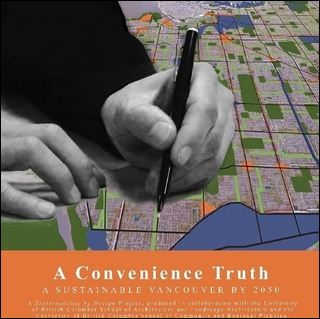
Another Fall book – this one from Patrick Condon’s shop at UBC: a collaboration by 20 student landscape architects and planners who in only 13 weeks produced a detailed 2050 vision for a sustainable City of Vancouver.
Seventeen students combined to do a 2050 plan for the City of Vancouver. The City of Vancouver is considered by many to be North America’s most sustainable city. ith growth pressures unabated, and with housing never less affordable, the big question looms: what next? This is where this book comes in. It contains the answers provided by a team of young visionaries. They discovered that as the city becomes more efficient, more diverse, more intensely utilized, and more equitable, it also becomes a more and more convenient place to live.

Patrick comments:
It is my pleasure to promote this book, a book emanating from a new generation of urban thinkers.
Along the way they discovered that Vancouver can easily double in population, and become dramatically more affordable and sustainable at the same time. Importantly, they discovered that this could all be done through organic growth, using the city’s original Streetcar City grid of main arterials as the armature. (The “streetcar city” framework, left over from a time when most of us got around on foot, on bikes, and on transit can still provide the framework for a city where most people get around on foot, on bikes and on transit.)
Most importantly, they discovered that this evolution to a more sustainable, diverse, and affordable future does not require the massive high rise focused and multi-block interventions we have become used to. Rather than more and more developments like Coal Harbour and Yaletown, and a more and more expensive skytrain transit systems to tie them all together, they chose a much gentler, much cheaper, primarily low-rise housing strategy – a housing strategy that would be much easier and cheaper to serve with zero greenhouse gas electric trolleys and trams.
In short, they discovered that as the city becomes more affordable, more diverse, and more energy efficient, it also becomes a more convenient place to live. That is why we call it the “Convenience Truth”.
The easy way to get the book is download it for free from here. Or possibly from lulu – here – though it’s a massive file. Or, for a hard copy, from UDI for $24 – here.





Some nice ideas presented especially in Chapter 6, too bad the transportation comparisons in Chapter 1 are presented in such a biased way. A little less selective picking of stats would be good (does anyone really care what the capacity of a single vehicle is compared to the system capacity? What are the cost comparisons…$/km??? Anyone expect that a streetcar line could get built in Vancouver for triple that number?….Ok maybe double….I found the footnoting/referencing almost impossible to follow and could not track the source for individual charts/facts….Of course I had a similar problem with the Translink Broadway/UBC study…..
Off topic but wanted to share this with you. Have you seen the NFB film/project One Millionth Tower? You should check it out! All about reimagining low income housing in Toronto and done in a unique multimedia environment that you can explore or just watch. http://highrise.nfb.ca/onemillionthtower/1mt_webgl.php
It’s probably a good read, but i notice that Condon can’t even write the promo without putting in a shot to his favourite anti-Skytrain biases. It’s not very convenient to spend billions of dollars on a streetcar system that doesn’t actually improve mobility compared to the existing bus system — especially the trolley bus system, which also has the advantage of being zero-emission for operations (both trolley buses and trams, of course, have lifetime emissions for construction and dismantling).
Tessa. It would have been polite for you to acknowledge that electric trolley bus is included as a viable avenue for zero GHG in the promo. I have come to feel that the most important thing for Vancouver is to start the project of a zero GHG transit system. Trolley bus and Tram are both aspects of such an approach. If we get to zero GHG with just trolley bus, ok, sign me up. Skytrain and diesel bus, the current path, doesn’t get us there. Certainly not affordably.
While I completely agree that we should move to a zero-ghg emission transit system in the medium term, and that trams and trolley buses both have a role to play, skytrain has a role to play in that, too, as does a more developed LRT system. Building a trolley on Broadway will do nothing to improve mobility on that street. Obviously we can’t blanket the entire region in skytrain, but I find it frustrating that this mode is consistently eliminated from your projects I believe unfairly.
I will commit myself to reading this, I just haven’t got around to it yet, so I want to caution that my above comments don’t refer specifically to this work beyond first impressions, but rather your approach more generally. That’s why I wasn’t able to acknowledge your inclusion of trolley buses in this work, and I apologize for the oversight. it’s more a general frustration with the idea that it’s okay to spend money on replacing a slow-moving trolley bus with a slow-moving tram for no improvement in mobility but not a fast-moving skytrain, even when that skytrain can improve mobility for people who live all over the region and will provide the backbone network that helps trolleys and buses work most efficiently.
Patrick, in the short to medium term the most important aspect of reducing GHG emisions would be to attract trips from cars to transit (almost any form) or walk/bike (best option). This is why the Translink Broadway/UBC corridor study shows one of the RRT options as reducing GHG emisions the most of all the studied options including the LRT options even though as a vehicle the LRT is more energy effecient. I also have a question for you about your energy efficency chart where it shows streetcars as more energy efficent than LRT, since they are generally the same vehicle (with LRT in a Right of Way) I am assuming you are factoring trip length into the chart. Did I make the correct assumption? Does that not unfairly favour technologies that are used more commonly for longer distance trips (which will still happen even in the long term)?
@Patrick
The charts showing cost, energy usage and pollution per trip is particularly useless as these vary dramatically with the number of passengers per system. Trying to generalize like the chart does to claim there is a best solution for all routes all the time is really misleading.
As well, showing the GHG emissions for coal generated electricity is also rather pointless as the book is aimed at Vancouver where electricity is not generated by coal.
Rico. Interesting questions. Lets move this away from what I believe and what i have promoted, and rather recapitulate the alternative points view that exist on this topic
Generally in transit planning there are two camps. One camp believes that transit needs to compete with the car, attracting riders off streets and into transit for the kinds of trips cars are best at, long ones. Thus the first principles for transit decisions for most regions, not just ours, is how can we create a system that goes fast enough far enough cheap enough to do that.
The other camp believes that this is a race you cant win, and its not a path to sustainability anyway. If you want to get the vast majority of trips onto transit, you have to rethink your assumptions about how the whole region operates. In this second scenario, to make a very long story short, you strive for “complete communities” where the vast majority of trips are short and are via walking, biking and transit. In this second view long distance trips, while necessary, are not the major focus of transit investment. System performance at the district or community scale is.
Naturally this second one is more complex, as it requires much tighter integration of transit and land use planning, and requires a much more even distribution of jobs and affordable housing than we have now. But from a sustainability perspective, if you could achieve the second path, it would, according to its proponents, be cheaper and more sustainable.
As for your second question, the chart that you are referring to does take into account the shorter average trip length on tram vs skytrain. We wanted to look at that because we were interested in the correlation between trip length and the types of vehicles that served a district. If you read our more detailed report here : http://www.sxd.sala.ubc.ca/8_research/sxd_FRB07Transport.pdf you will see that we clearly and up front establish our premises. One of them, in line with the second “path” discussed above, asserts, as a first principle, that “short trips are better than long trips”. As a sustainability principle it makes common sense. But if one doesn’t accept this principle then one wont accept the results that are spawned by framing the question against this principle.
In short, having clearly exposed this principle in the work, we think it is thus fair to identify the energy savings based, not just on a per mile basis, but on a per trip basis as well. Its on a per trip basis that trolley bus and tram really seem to shine.
Finally, the book itself does not contain the charts you refer to, as Scot Hein and i and other reviewers thought they might confuse the issue or be read as biased. The versions on line have not been updated to reflect the changes to the printed version. I am correcting that today. The more important message, that i hope the tram vs skytrain debate wont obscure, is that the City has the opportunity to capitalize on a very robust framework for adding over 300,000 housing units (and and equal number of jobs) and most of the opportunities lie south of 12th avenue.
“Generally in transit planning there are two camps.”
But in this case there is a third camp. I believe that medium speed transit that provides good regional mobility, and requires the re-allocation of a very significant proportion of road space offers the greatest short term reductions in emissions. It is the fact that they take up road space (and signal timing at intersections) that makes electric bus rapid transit and LRT good moves for reducing emissions.
These emissions reductions can be rapid as needed, whereas property re-development during a deep economic crisis tends to be very slow. And good transit creates the conditions for true transit oriented development too.
Automobile traffic volumes (and emissions) generally increase with increased road space available to automobiles, and shrink with reduced road space available to automobiles. Therefore, Surrey’s plans for surface rapid transit would have very different emissions outcomes with road space re-allocation to transit vs wider roads with just as much space available to cars.
Parking is the other key variable, people don’t drive to where they can’t park. People who don’t have parking tend to not bother owning a car, particularly if there are convenient alternatives including good transit and car co-ops.
Richard. We used coal fired energy to avoid the complaint that we were “cooking the books” by unfairly favoring electric vehicles over oil fueled vehicles. We wanted it clear that even if you use coal, the GHG consequences of a trip on electric transit was way less than on Diesel. As for the utility of the charts thats for all users to decide. They are correctly researched and the premises behind them clearly laid out.
The non-transportation related urban plan seems fine, the transportation stuff seems a bit wobbly. It’s not a completely unreasonable vision, but I’ll need to read it in greater detail to formulate a more definitive opinion about it. I took a quick look at it so I only have a few observations for now.
I agree with Rico’s observation about the citations. They are a bit bizarre and difficult to follow. This may be down to style and the fact that it was drilled into me that specific claims need to be cited. But, in some places it seems as if were meant to just take the authors word for their claims as if they’re uncontested truths. Not to be rude, but I don’t think something like that would’ve been acceptable in first year university, much less something produced at the graduate level. Further, it would be a bit more of an effective argument if Patrick Condon’s own studies weren’t constantly referenced. A neutral third party would be more convincing.
In addition, some of the costing assumptions both capital and operating seem very optimistic, to put it mildly, for a street car system. I’m naturally reluctant to endorse anything that seems too good to be true and the costs cited for a street car system seem far too good to be true. Further, there doesn’t seem to be much of an acknowledgement that a street car system is essentially an upgraded local stop patterned service, which is what the bus system already does. Though I’d assume this is due to the natural belief, inherent in Patrick’s previous work arguing in favour of a more locally focused life, where trips greater than a few kilometres are largely eliminated.
Patrick, the problem as I see it is a matter of timeline and transition. Changes like you are proposing will take decades or generations, so if you base your transit investment choices on your desired outcome before there is sufficient support for it (better distributed services, jobs, sufficiently dense neighborhoods). Those investments will provide a poor return (in service, costs, benefits etc.) and will increase resistance to additional investments (observe the many poorly performing LRT services in America and the resistance to additional LRT systems despite many very successful systems). Change needs to be incremental, we will need medium and long distance transit for at least the next 30yrs so we should be looking at where we get our best bang for the buck in that timeline (for me the main metrics would be cost per gain in transit/bike/walk mode share, total GHG emissions (including the cars removed from the road) and impact on the built environment. It may be we get a better return if we spend more….or less, the trolleys where they exist are a good system.
Yes Rico.
I admit to being an “idealist” on this topic. My job, in my research chair at UBC, is to think in terms of long range sustainable outcomes. It is a process by which you look into the future (often using the 2050 target first identified by the Intergovernmental Panel on Climate Change (IPCC 2006) as the point at which atmospheric GHG has to stabilize (in order to avoid catastrophic global climatic consequences).
Then, with a reasonable 2050 scenario in hand, one “back casts” from that to see what you need to do this decade to work toward that desired outcome. On the other hand, if you make decisions based on present circumstances and incremental gains (as i think you argue for), you might be making practical decisions in the short run, but might also be foreclosing options that would give you better long term results.
I start from the belief that our overaching imperative is to get our region to an 80 percent reduction in GHG by 2050, all while increasing our population. Our commitment to this must, of course, be part of a nationwide commitment to do the same, and part of a global commitment to do the same as well.
It may seem idealistic for us to use this benchmark to guide our decisions, but on the other hand, NOT to use this goal, ends in catastrophe.
Patrick, my point is if you were to invest in a large streetcar system for Vancouver today many (or most) routes would be have poor returns on the investments and further investments in Transit would suffer resulting in more GHG emissions. This investment would drive medium and long distance users to alternatives to transit (as rational beings they would use the system most suited for them) resulting in more people driving cars. If you enforce ‘local’ travel on transit you will lose people using transit now. The land use patern must change sufficiently to allow a ‘local only’ option to be viable (which in most neighborhoods it is not today). An investment in rapid transit will still suport the land use changes to help a sustainable city while providing transportational advantages today…and since people see it working and like it (aka Canada Line) they will be more likely to support additional transit investments.
Planning for the “long term” without consideration of the short term isn’t very long-term focused at all. What is ideal in the long term is not practical in the short term.
As rico has mentioned, enforcing “local” travel on transit is ideal, but not practical. The reality is not everyone has the luxury of local travel on transit.
Actually the most ideal mode of travelling is by foot not by transit. With Patrick’s logic, we should remove all transit altogether to enforce people to travel by foot. What you will find is people reverting to cars. Probably a drastic example, but the same reason is true in enforcing people throughout the region to use a local transit mode for travelling.
Thanks for all the interest in this topic. I will try to answer some of the concerns in this one post.
First off, the most robust exploration of this fast transit vs slow transit question is provided in my Seven Rules book. Its really hard to provide a simple answer to these concerns without going into depth and if i do that i just repeat arguments made there. So here i will just say that I don’t agree that what is ideal in the short term is not practical in the long term as Josh suggests. The ideal is to do both. If we make the wrong types of decisions now we foreclose possibilities for a more sustainable region in the future.
Lets take Surrey as an example. Diane Watts has been promoting surface light rail, essentially street located trams, for Surrey over Skytrain extensions. She has said, correctly i think, that Skytrain is simply too expensive to build out to every corner of Surrey, but tram is not. She has also said, in her recent state of the city address, that “transit is not about getting as fast as you can from point a to point b. Its about building community.” In this she very efficiently states the real issue. If you pour all your money into speed you cant reach all the people anyway, and you miss the chance to build community along the way.
As for the common complaint that it makes no sense to spend money on trams on routes that buses serve adequately, fine, Switch to trolley bus next time you have to renew the fleet. But on heavily traveled bus routes like Main and Hastings the ridership is already high enough that tram merits consideration for the cost savings they provide over a thirty year amortization period.
Finally on the issue of Broadway (groan) . My basic horror is the expense, not any antipathy to skytrain. If skytrain was free, heck, build it to right in front of my office. But a deep bore subway tube out to UBC was costed at 2.5 billion by the Province 6 years ago in their transit plan. That’s for 12 KM. So its over 200 million per KM. That’s way more than the Canada line, and more than twice as much as the Millennium line. That’s way too much in a region that is screaming for transit. I feel like Mayor Watts makes a better case for investment in surface light rail south of the Fraser than we do for a subway under Broadway. Whatever one feels about the Skytrain to UBC issue on the merits, it seems politically unlikely that the Feds and the Province will pour that much money in to serve one school and an area that is already pretty well served with transit when the rapidly growing urban region south of the Fraser is so transit deficient. I think we have a decent chance of get something for Broadway in the .5 to 1 billion dollar range but not in the 2 to 3 billion dollar range. Even i agree that the stub of the millennium line should be connected to the Canada line. That just makes sense. After that, how far do you take it? Granville? Maybe. Burrard? Maybe. Arbutus? Thats sort of a stretch, but if you built the downtown tram line as proposed by the city (its on their web site still) and bring it up to Broadway and Arbutus via the old interurban ROW, well, that might make sense. But all the way from there in a tunnel out to UBC? Not logical. Not affordable.
Anyway, there is more to say, about capacity not really being an issue given the train lengths available. There are conversations about signal priority, all door loading, and the distance between stops – all these have an influence on speed, And even if you dont go all that fast with the tram, skytrain only gives you a 12 minute advantage. That’s a lot to spend for 12 minutes. And if you looped the tram at UBC a lot of students would regain that 12 minutes, because their typical 12 minute walk to many buildings from the likely station area would be eliminated. Unfortunately this discussion always goes on and on and, in my experience, very few minds are changed by it.
The point that the students make in the book is a larger one than that. They concluded that we need to find a way to create a ton of affordable housing in Vancouver, and more jobs for our citizens. We need to find a way to do this that lightens our load on the planet. The way to do this, it seems, is to recognize the capacity of our neighborhoods south of 12th to absorb a ton of new jobs and homes, without the need to radically change them. When we do this we need a GHG zero way of getting around. Trolley bus and Tram fit the bill, and they are affordable too. The real question is when do we start, and where.
The best way to ensure that your vision of a sustainable Vancouver fails would be implement the transportation component of your vision right away. I guarantee that within 10yrs it will be a textbook example of why good ideas can fail when poorly implemented.
Ignore the short term at your peril, if you have a good idea (like several within Chapter 6) that is not practical today because it can not exist without massive change attempting to implement the idea without changing the reasons it is impractical will ‘prove’ the idea was flawed and result in the idea thrown into the pile of ‘failed’ urban experiments. What a rational person would do is select the best options that work today that do not preclude your ideal future vision (heres hoping policy makers are rational…).
As for Surrey, LRT should work well on the corridors proposed in Surrey resulting in IMPROVED mobility (exclusive Right of Way, Signal Priority etc). The fact that it will build the community does not mean an alternative vision would fail at building the community. For the record I would be in favour of LRT in Surrey (but only suspect it would be the most ‘cost’ effective). This does not mean that Bus Rapid Transit or Skytrain could not also work. Different systems will provide slightly different benifits and have different costs/returns on investment (obviously all the systems should be evaluated prior to proceeding).
Not sure but maybe someone here can help…I would suspect the majority of users on Main and probably Hastings are medium to long distance travellers where speed is a factor and some sort of LRT would be preferrable to ‘Tram’ (I know see my previous comments about dealing with the realities of TODAY).
As for Broadway I would suspect at least as far as Arbutus the more expensive Skytrain option would have a much much better return on investment (Mode share shift, GHG emmision (counting cars removed), etc.) than a Tram system (actually than an LRT system, on Broadway a Tram would probably be listed on exam questions as What was the stupidest thing ever done for almost 1 billion dollars in Vancouver?). A UBC loop for the Tram would just add distance for the Tram and therefore GHG, students can walk (GHG friendly walking or biking).
Sorry I am so hard on your Transportation ‘Vision’, it is because you truely have many good ideas and I would be sorry to see those fail because your Transportation framework is so flawed (at least it seems you are slowing getting a little bit more flexable from the ‘Seven Rules’ days, here is to continuous improvement).
I had got a glance at chapter1 last week, and look at t again and saw it has been edited for the better. We are on the way of progress (You can still check some statistics at http://voony.wordpress.com/2011/11/28/some-translink-statistic/ )
One could take objection to some figures:
the Vancouver streetcar+ interurban network at their most extend (1940) are compared to the Skytrain + WestCoastTrain…
Not all the thing running on rail are comparable!
A second concern is the study of Melbourne…here is the same, the Melbourne trams network is compared to the Vancouver Skytrain one (it seems the map are not at the same scale, Melbourne trams doesn’t go much farther than 10km out of Downton) :
it is like comparing the Portland streetcar network to the Skytrain one. Honestly it is kind of ridiculous!
Melbourne is also presented as a city with 16 lines of metro (more than in Paris!)…
a metro in the popular meaning involves an high frequency service.
the “Melbourne Metro lines” can run at frequency as low as hourly.
In fact it is not a metro, it is a “S-bahn”, which has more in common with the Zurich S-bahn (it has an underground section, the loop, in the DownTown, acting as a metro, because all the train go thru it, but frequency for a specific line is usually low)…the S-bahn concept is very unknown in North America but if the Skytrain network needs to be compared to something in Melbourne, it is the S-bahn, not the trams…The Melbourne trams need to be compared to the Vancouver Trolleys, if anything.
And yes, the skytrain is far less extended than the Melbourne “s-bahn”, for some reasons. One being that the North America rail regulation, make the S-bahn concept (and a fortiori its little brother the tram-train) a very unpractical idea here.
Thanks for the work, hopefully your stats will make it into the revisions.
@ Patrick, sorry I did not go back to your posted material till today. I think Chapter 1 is much improved and will help keep the focus on the rest of the ideas in your book.
Reblogged this on metrobabel and commented:
From the desktop of Gordon Price. I will have to download this new book from Condin et al when I get home.