

Vancouver moments while cycling around the peninsula:
Like, street hockey among the daffodils.

__________________________
But where are the cyclists?

Biking is still the fastest way to get around, there’s valet parking close to Games events, the weather is perfect – and while numbers are up slightly, it’s nothing like I would have expected. A week ago we cycled out to the Pacific Colliseum along the Adanac for pairs skating, only to find only a dozen other bikes in the secure parking.
So why aren’t people cycling more?
__________________________
A rock balancer displays his craft along the False Creek North seawall.

__________________________
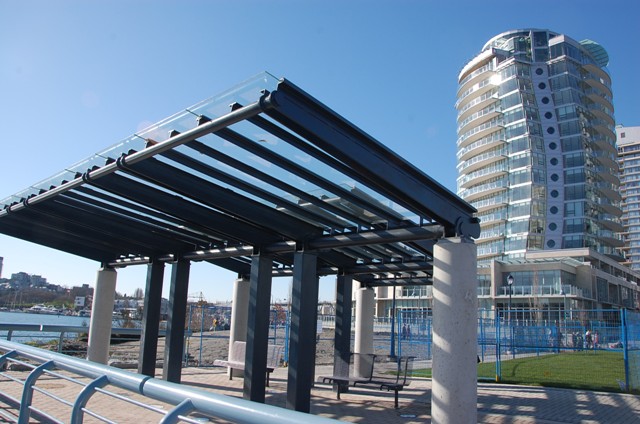
The latest False Creek ferry dock is open at the southwest corner of David Lam Park – and they’ve built a sturdy waiting pavilion next to the Erickson. It says: we take these little ferries seriously enough to keep you out of the rain while you wait.
And the new Sea Star Children’s Centre nearby says: we take child-care seriously too.

__________________________
Sorry, but the Yaletown Park at Nelson and Hamilton is still a bust.

Even on a perfect day, when the docks of Yaletown are overflowing and the streets are full to bursting, this hard-surfaced open space attracts only a handful, who really don’t have anything to do. The children can’t play safely, the undulating surface discourages the toss of a frisbee or ball, people don’t hang around. The trees don’t even look happy.
But we’ve never looked better.

I mean, better dressed. Maybe everyone looks good in red and white, especially when the shirts and jackets are athletically cut, they’re new, they’re clean, and they serve as the informal uniform of the multi-racial young. And as the French know well, everyone should wear scarves
__________________________
Probably the quietest place downtown is the Olympic  Village . Hardly a soul along the seawall (and why is it fenced off anyway?). The streets and squares seem empty from a distance.
But hey, I suppose a quiet, protected place is exactly what the athletes want – and as the final days approach, things will liven up.
Anyone experienced it first hand?
__________________________
As a combination of engineering and art, these pipes from the district heating plant next to the Cambie Bridge are brilliant. The heat is tapped from the sewage main that lies unerneath, and the tops light up to indicate the amount of energy being used. One thing though: can’t we paint the pipes something a tad more exciting than industrial gray?

__________________________
It didn’t get a lot of publicity, but the streetcar collided with a vehicle at a level crossing. No evidence of damage, though. I’m told Bombardier technicians worked through the night to get it back in service within hours, looking as good as when it arrived from Brussels, to which it will return. But not without a lot of people wanting something just as good for Broadway – or any other part of the region that’s demanding something more than infrequent service by diesel bus.

Another curious phenomenon: check out the number of tourists on this truck:

Two. And that’s not untypical. How come? Have people converted so much to walking and transit that traditional ways of getting around – especially by car – have been discarded for a different kind of freedom?
This, folks, is the entrance to Granville Island on a sunny Sunday afternoon – a view of empty asphalt probably not seen since 1977.

Amazing. Will this change the debate over how we allocate road space after the Olympics? Never again can anyone argue that we can’t remove car lanes without creating traffic chaos.
__________________________
One significant improvement has been the information panels, providing not only directions but also, critically, an indication of how long it takes walk to other destinations – say, 15 minutes from BC Place to the cauldron.
Kudos to the Streets Department in Engineering and to the graphic designers for the new kiosks – another small but worthwhile legacy from the Games. Another assist to the way that Vancouverites will think about time and space in their city.
__________________________
To end, as we began, with more street hockey, this time in the middle of Robson Street:





I think the one thing you have to realize is that the 2 weeks of the Olympics are not typical – in many ways.
– People are, in essence, on vacation. Our office is absolutely empty of workers – whether they are attending Olympic events, volunteering or have escaped the city.
– Transit is free for Olympic event ticket holders. So spectators heading to the Pacific Coliseum would take transit rather than ride their bikes (assuming that everyone in a group is able to ride a bike) or drive their cars. People are being shuffled by staff onto trains and buses without even needing fares.
– The Olympic crowds downtown are not on time-sensitive schedules like they would normally be during a work week, so they are more forgiving of delays. The 5 hour line-ups at the Royal Canadian Mint pavilion are evidence of that. Ditto for line-ups at SkyTrain and Canada Line stations and any of the free Olympic events.
– As for the touristy stuff, people can do that any time – they’re currntly getting their Olympic fix. When the Olympics are gone, they’ll be gone.
It’s nice to see that so many people are having a great time of it.
While the seawall and a few other places are nice to ride on, I don’t think the network is to a point yet where that many people can ride in safety. Until places like the seawall are connected to the Burrard Bridge lane and beyond by separated (safe) bike lanes, cycling will always be an afterthought (relatively speaking) in Vancouver, practiced by those dedicated or brave enough, and not by the masses.
My $0.02.
With respect to the absence of cyclists on the seawall, it may be that locals (those presumably most likely to cycle) opted to avoid pedestrian congestion and rerouting around venues in favor of taking designated on-street bikeways. I’ve seen a great deal of traffic on the 10th Ave, Heather, and Off-Broadway bikeways, for example; far more than usual.
Some ideas about the seawall:
A lot of people bike along the seawall for recreation, trips that aren’t really necessary. It’s more annoying to bike around the seawall with segment blocked off at the Olympic Village, and the dismount segments at the Plaza of Nations and at David Lam park. Add in all those pedestrians, and it’s become a hassle to bike there. That and there are better things to do.
I suspect the number of people using bikes for transportation is about the same. At least it’s as busy as ever up here on 10th.
The wayfinding signs are great. The maps are specifically for the Olympics. Will they be kept and updated for post-Olympics Vancouver?
Another little change I like, not in implementation but in the effect, is the hard paving on the north lawn of the art gallery. It’s just plastic, and it feels terrible, but it makes it look so much more inviting, it draws you in (from Howe and Georgia, at least). The small area of hard paving beside the fountain towards Howe was too small, and it felt claustrophobic. Now, it’s almost like a square.
They only put the plastic tiles down in front of the Art Gallery because of years and years of treading by people, the grass wore down to bare dirt. I guess the cost of mainaginag the grass was too expensive.
I remember 10 years ago when it was lush grass and office workers would lie out on the grass at lunchtime on sunny days during the summer. Back then, there was a small plastic chain “fence” surrounding the lawn (the kind that gardeners install to discourage pets from entering a flower bed), but over time, people kept cutting diagonally across the lawn, wearing a path across it. The gardeners finally gave up trying to maintain the grass and installed paving stones for that diagonal path, which destroyed the intergrity of the rectangular lawn and the grass has now disappeared.
I would like to see the whole front lawn of the Art Gallery removed, and the entire space between the building facades on all flanking streets treated as a central public square, with continuous decorative paving across the current blacktop area. The traffic could still flow along Georgia etc., but the paving texture change and other design elements (including hydraulic bollards to close the space off for special events) would signal entrance to a grand urban room.
Mark: good suggestion
Yaletown Park design is also more appropriate for a mid-heavy used space like the Art Gallery lawn could be than a neighborhood park…
here is a link to illustrate such design (Yaletown park one) can work when the context is appropriate:
http://www.coteacheteur.com/immobilier/Rennes-Place-Ste-Anne.jpg
I see no evidence of increased bicycling on the Central Valley Greenway Monday to Friday when I commute between 8:30 and 9:30. Basically still me and 1 or 2 other people on CVG, a few more folks on Quebec Street but no real increase from pre-Olympic levels.
I’m not too surprised at the lack of increase in cycling. The transit system has been terrific, especially the trolley frequency of those within recreational cycling distances. Add to it the difficulty due to the crowds along the seawall, the ban on bicycles on rapid transit, the closure or pedestrian mass of many of the quieter streets (especially off the Cambie Bridge), the detours, the olympic lanes where cyclists are prohibited, and people wanting to stay out a bit later, and there you have it.
One issue that I’m surprised hasn’t been raised yet is the legacy of the Jack Poole Plaza and the possibility that the cauldron might remain there, and remain lit at that. I had some hope for this space, as a venue or a gathering space, as it would be one of the largest open spaces in the downtown. But I can’t see that happening with a cauldron in the middle of the space, and all the fencing that would be required. On the plus side, people could sit around roasting marshmellows and singing campfire songs.
About the only good thing that can be said about Yaletown Park is that the rough granite setts make it pretty much skateboard proof. Skateboards have their place but it’s not slamming and banging in the midst of high-density areas with planet of noise reflecting surfaces, and ears to hear them.
However, there is a great innovation in the photo, public toilets! European and Japanese visitors must have been stunned at how poorly we supply these. Of course those shown are likely back in storage now that the crowds are gone. Still, the Olympics showed how we need both better WC’s and wayfinding to be as visitor (and resident) friendly as a City of Vancouver’s stature should be!
” Never again can anyone argue that we can’t remove car lanes without creating traffic chaos.”
================================
Is this a prediction that in the civic elections of 2011 the bike lane on Burrard St Bridge will not be an issue, that it will be just accepted by both Mayoral and all Council candidates? If so, I think the prediction is wrong. I expect Susan Anton to promise WestSide motorists that she will remove it the moment she takes office.