
And so it begins.
I’ve been surprised how little Olympic buzz there has been in Vancouver so far. Maybe it’s the weather. Maybe it’s a strategy. Don’t peak too soon.
In the last week, that’s changed – with the unwrapping of the wraps.


The best super-graphics so far are on the Hudson’s Bay Company:

Christo-like, this wrap changes the perception of the building, emphasizing those unique columns (they’re unlike any classical order I’ve ever seen), and literally gives the structure a human face.
The face grabbing your eye on Granville Street is of Carter Rycroft, who’s described as ‘baby-faced’ in the sports columns. Um, I don’t think so. Whatever else, this image alone may change the perception of curling as the only sport you can still play while smoking. Yup, Carter is a curler.
The super-graphics won’t be confined to downtown. Here’s Central City in Surrey last week:

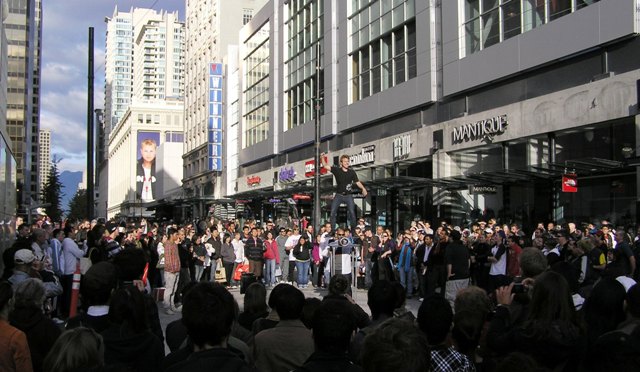
Apropos to Granville Street, while I was shooting the Bay I turned around to see a gathering of people that I thought at first might be a protest of some kind on Robson:

Rather, it was a busker who had attracted a crowd of hundreds, taking advantage of the empty right-of-way on Granville while the mall is still under construction.

As Lisa Brideau notes below, Granville Street, especially in this block, has the chance to be an extraordinary urban space in the city. And we’re not even waiting until it’s finished.
It’s an indication of what might be a real Olympic legacy. Just as Expo 86 changed people’s perception of downtown (being able to drink on an outdoor patio was just one small change), so may the closure of Granville, Hamilton and Robson, connecting the public venues at Larwell and David Lam Parks. By changing how people move around (along with the fact that no one is going to be able to drive and park near any event), we may take another giant step towards the post-Motordom city.





Vancouver should take advantage of this Jan Gehl moment and keep Granville completely closed to traffic, buses, the lot, and turn it into a complete pedestrian promenade. From the photos it looks like people are ready for it. With transit nicely underground, this could be a wonderful Stroget-like space.
I don’t neccessarily agree with the idea of closing Granville completely to traffic. I think a better aproach is shared use and traffic calming, with certain blocks closed off to traffic at certain times (like for summer festivals and weekend nights). The risk of completely closing it to traffic is businesses suffer and things go back to the way they were as a result. A small amount of calmed traffic can make a street feel more ‘active’ when pedestrian traffic is small.
One of the failings of Canada Line in my view is it isn’t very ‘visible’. It’s mostly hidden underground where you don’t see it. Transit should be made highly visible so people constantly see it and are encouraged to use it. Having trolley buses go down Granville makes them visible. Perhaps only allow trolley buses between W Georgia and Robson.
One more thing – traffic calming should be a high priority for the W. Georgia/Graville intersection. The Canada Line station has increased pedestrian traffic in this area and I’ve seen a number of ‘close shaves’ between traffic and pedestrians at this intersection recently.
Given that the City lacks a proper urban square – I think asking for 2 blocks of Granville to be pedestrian-only isn’t asking for much. If we program the space correctly (seating, vendors, cafes, etc), then businesses won’t suffer – I think that fear is left over from failed 1970s pedestrian malls. The pedestrian traffic volume on Granville st is not small – it’s a very active street these days – which is why it is so ripe to be pedestrianized, I think.
Traffic calming is great, I fully support it, but a traffic calmed street is not a pedestrian only street. You can’t have buskers with huge crowds in a traffic calmed street, for example.
“You can’t have buskers with huge crowds in a traffic calmed street, for example.” – true but would you get those kinds of crowds all year round? Remember the most successful public spaces are those that have a steady stream of activity all year round and for most of the day. Good weather draws crowds of people but you have to work harder to entice people to congregate in times of bad weather.