
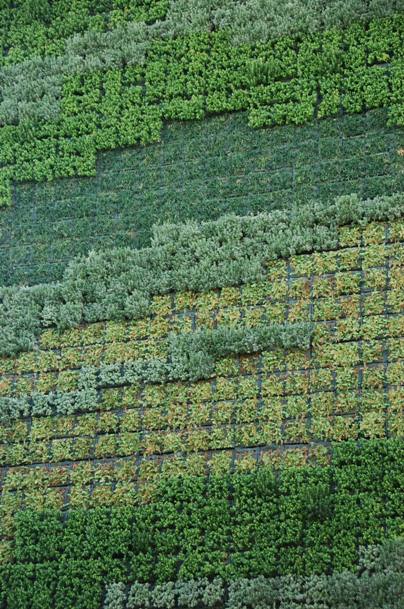
On arrival back from greener-than-thou Portland, it was a treat to see, immediately on exit from the international terminal at YVR, the new green wall on the parking garage:

Or is it related to the Canada Line?
I suppose it’s a statement of sustainability (though it’s not clear to me exactly what a green wall does). Maybe it’s more public art – a living quilt.





It’s a green band-aid hiding the ugly concrete wall behind it.
It’s part of the Canada Line upgrades, and you are correct it doesn’t really do anything or serve much purpose, it certainly is nicer to look at then a blank wall, and I’m sure it’ll limit graffitti. Plus it probably subtracts from from the urban heat island instead of add to it.
Imagine a solid green wall like that around the Sears building downtown though, it would be spectular.
Joe, Gordon wrote that he’s not clear on what exactly a green wall does. He did not write that the green wall “doesn’t really do anything or serve much purpose,” so why are you saying he’s correct in thinking that?
There’s a difference between not knowing what a green wall does, and thinking that they’re pointless and have no purpose.
Also, do you realize that you said the green wall doesn’t do anything and has little purpose, then you immediately go on to describe 3 functions of the green wall? So which is it? You contradicted your own statement.
It seems to me that the green wall does do something and does have a purpose. In fact, it does more than one thing, and has more than one purpose.
We’re lucky that there was someone with enough design sense that was willing to promote the idea of this green wall. This kind of stuff does not happen often or easily. Usually you’ll just get a blank concrete wall because the authorities in charge are rarely willing to pay for interesting design.
Please don’t be so quick to dismiss such important design features as though they were nothing and pointless. It’s things like that green wall that give places a unique personality and character versus all the other boring generic places we’re surrounded with everywhere.
When people put the effort into creating such design features, I wish people’s default reaction would be to support it rather than automatically being cynical and pessimistic.
we recently blogged about the green wall at YVR. check out the post here: http://yvrconnections.com/2009/06/greening-up-our-walls-at-yvr/
Just to clarify my post, I reckoned that Gordon was hinting at what does a green wall do implying it doesn’t do much, in which case he is correct. (Could be way off as to what he meant) Unlike green roofs on enclosed buildings a green wall on an open parkade does minimal for any engery efficiencies. It is mostly fluff, beautiful fluff but fluff none the less.
I’m all for this wall, don’t get me wrong, as I hate blank concrete walls, but wether it’s an efficient use of money I’ll leave that up to the experts.
Joe, you might want to step back from the idea that green walls are just fluff and they don’t do very much. You’re kind of exposing yourself as someone with very simplistic thoughts.
Green walls have a number of functions:
1. Plants clean the air we breathe. We pollute the air, plants clean it up. So introducing more plants to our built environment is a good thing. Being able to breathe clean air is kind of important to humans.
2. Green walls reduce noise, they act like sponge for sound waves, which is especially useful for areas with a lot of people, cars, planes, and skytrains.
3. Green walls are a graffiti deterrent, because you can’t spray paint on them like you could do to a normal wall. Not only is graffiti unsightly, it’s very nasty for the environment because of the paint used in the creation of graffiti and what’s worse is the nasty chemicals and stuff that is used to remove it or paint over it again and again and again.
4. Green walls become a habitat for insects and birds. We destroy animal habitats every time we build something, but there are things we can do to bring some of it back, green walls are an example of this.
5. Green walls collect rainwater and naturally filter it in the local environment, which is better than allowing it to run off into the sewer system.
6. Travelling is very stressful, it’s nice to be surrounded by things that provide a sense of calmness and naturalness. This green wall has a relaxing effect. The last thing we need people doing is getting in their car and heading out on the road all unfocused and frazzled and getting into an accident and killing people.
7. This specific green wall sends a message to everyone visiting Vancouver (and Canada). That message is that we’re a progressive cosmopolitan city that cares about the world and the environment, and we’re open to using new methods and technologies because we’re also big on innovation. We’re a player in the world. Interesting things are happening here. We’re not just some cultural backwater of flannel shirt wearing people who live in cabins.
8. Green walls are aesthetically appealing. They provide something nice to look at instead of boring concrete walls. If green walls didn’t do anything else besides this, they would still be worth it.
How many functions does something need to have before it’s not considered “fluff” anymore?
Is it really that difficult to just acknowledge that green walls have many important functions?
I’d also like to say that green walls are symbolic of 21st century thinking, where we have a much more holistic approach to the way we do things now compared to the way we did them in the past. We try to work with the environment now insead of fighting it like we used to. This is a revolutionary way of thinking, its not fluff.
Wow, John. Do you think you could sound like more of a condescending prick? I am not quite sure you fully captured your arrogance in the posts you have displayed here.
I’m not trying to be condescending or arrogant.
I generally try to avoid that and stick to the subject.
I’m sure Joe is intelligent, but I do think he’s being a little lazy with his thinking on this subject. It’s very easy to make simplistic derisive comments on blogs, but it requires a little more effort to actually put some thought into the subject and provide some insightful analysis.
Quickly dismissing this green wall as “fluff” is both simplistic and disrespectful to the people who put the effort in to create it. It’s also surprising (and sad) to see such lack of support and understanding for a contemporary urban design element on a blog that is a big supporter of good urban design.
The world could use more green walls, not less. The last thing we need is people dismissing the few that exist as useless, especially if it’s because they haven’t put much thought into the subject.
Fully understanding all the functions of a green wall reminds me of another urban design element which people often dismiss as fluff when they just make a superficial observation.
The walls of most underground parking lots are not painted, they’re just bare concrete, which tends to make them kind of dark. For years, architects and urban planners have been suggesting to building owners that they should paint the walls of their underground parking lots, but most owners just dismiss it as fluff, unnecessary decoration that they don’t feel like paying for. Until finally some studies started coming out that showed that if you paint the walls of your parking lot gleaming white, it greatly reduces the number of break-ins and theft from cars, which saves money in insurance, security costs, etc…
So painting a wall just sounds like a bunch of unnecessary fluff decoration when you make a superficial observation, but if you’re not so quick to dismiss it, you might realize the intangible functions and benefits that make it much more valuable.
Green walls are a lot like this. On the surface, it just seems like a nice thing to put on a wall, but when you learn the full story, you can see so many functions and benefits that weren’t very obvious before.
Not to mention the fact that these walls insulate a building during the winter, and cool it during the summer. Plants are a natural and renewable resource that should be taken advantage of.
Like rooftop gardens, these walls greatly reduce energy costs on a building and reduce the urban heat island effect, which is important in reducing global warming. When placed inside a building, the walls can act as a natural air filter in place of an artificial air filter. These artificial air filters become saturated with pollutants and once they need to be changed, they are considered toxic waste and are even more harmful to the environment.
These walls are far from just aesthetic beauty and fluff, they are extremely important and, with any luck, will catch on in the US and have a true impact…
I am well aware of the benefits of green walls, but we are talking about this pratically green wall, it does nothing to increase enegry efficiency as it’s against an open aired parkade which isn’t heated or cooled. Had the wall been covered with solar panels for the same cost it would at least produce engery to be used elsewhere. Do not get me wrong I’m all for green walls, but this one is for a lack of a better term a fluff piece.
That said if they were to cover the Eaton/Sears building with a similar wall system I’d be the first to applaud it, mind you the building would be gaining the complete advantages of such a system.
But in fact, this wall does cover a stretch of what would be solid concrete, which is not only an impermeable surface, but also a contributor to the urban island heating affect. By coating the wall in plants the temperature of the wall and the surrounding area is greatly reduced. Thus this wall does in fact have a significant environmental impact even if its not insulating or cooling, or increasing energy efficiency. It is simply reducing the reflection of UV rays and reducing the greenhouse effect.
When it was being built, I thought that it would just have vines growing up the side of the Station (like have been on BC Place Stadium since the 1980s (unless those have been removed for the renovations?)).
From pics posted on Tafryn Palecloud’s Canada Line blog, you can se that the green wall has a complex system of watering pipes to keep the plants alive.
Link to Tafryn’s pics here:
http://canadalinephotos.blogspot.com/2009/07/2009-07-03-yvr-station.html
This pic shows the irrigation system:
http://www.seataf.com/blogs/canadaline/2009-07-03/images/IMG_1348.jpg
green walls are one design solution – as with all design solutions its appropriateness is site dependant –
How well is this one holding up? There is a green panel (not a wall by any stretch) installed on the Capital Regional District’s building in Victoria, and I am dissapointed to see that the plants appear to struggle.
Art Doesn’t have to have a physical function. It inspires people and enlightens their every day and lives. That’s all a Green Wall is, Art. Same thing for most landscaping.
Form over Function.
Commonly known as “aesthetics” or just “good taste”. Plus, in this case, the green wall also performs useful functions, as in reducing noise and heat dispersion.
Howdy would you mind letting me know which
hosting company you’re working with? I’ve loaded your
blog in
3 different browsers
and I must say this blog loads a lot quicker then most.
Can you suggest a good web hosting provider at a fair price?
I think he uses WordPress’s in-house hosting service. I believe there are both free and paid options available, but the catch is somewhat less flexibility compared with a full service provider.
Firstly, I want to thank you for the very useful information you posted
here about low back pain. I work as a professional fitness and pilates trainer| and I have met people with lower back pain.
I myself had some problems with my back previously and
I can tell for sure that fitness will definitely help
if you aware of methodologies or work with professionals