
I’ve been wondering for awhile whether, in the current housing meltdown in the U.S., location would make any difference on house prices and foreclosures. In particular, would the length of a commute now constitute a disadvantage great enough to overcome the “drive ’til you qualify” mortgage advantage of distant development?
Yup, apparently it would.

According to this piece on National Public Radio:
Recent studies suggest that buyers underestimated the costs of their long commutes. Those expenses can add up to more than the buyers saved on the home. Developers also miscalculated, lured by cheap land and rising home prices. They overreached, “partly because the bubble collapsed, but partly because these developments were just bad ideas to begin with,” Stiff said.
Many of the projects were simply too far away from places that people need to go.
On the other hand:
It’s a different story for properties that are closer to the city’s center — in areas of Montgomery County that are on the edge of Washington.
“When I have a listing in this neighborhood, there are often 40 to 60 people coming through the open houses,” said Pam Ryan-Brye, an agent with Long and Foster Real Estate.
You can even see the difference from space. Here’s the area pictured in the NPR story above – Clarendon, VA – which I also explore in Price Tags 97. The orange line is the Washington Metro rapid-transit route.

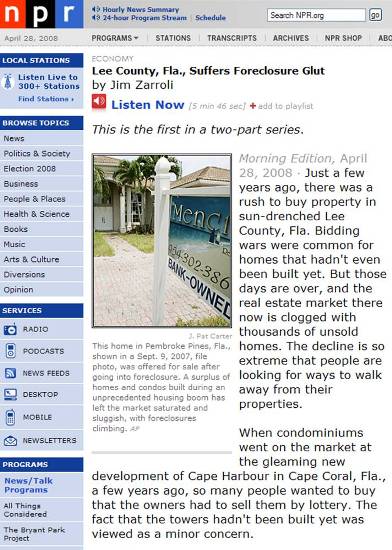
Whereas here’s the part of Florida that has the highest foreclosure rate in the nation:

NPR talks about Lee County here.

As prices have fallen back to earth, owners have increasingly found themselves owing more than their properties are worth, and are walking away from them, helping to create a backlog of more than 19,000 unsold homes — about six times as many as two years ago.





Also according to NPR, apparently people in Portland Ore spend an average of 10% of their disposable income on transportation while people in LA and Atlanta spend about 35% of their disposable income on it. That’s a lot of cash literally going up in smoke.