

Back again – and working on Paris for upcoming Price Tags.
In the meantime, went to hear Copenhagen architect Jan Gehl in Richmond (Stephen Rees does a nice summary here). And was surprised at the impact of the Canada Line guideway down No.3 Road.

Now I understand why Richmond Council wanted an at-grade right-of-way – even if it wasn’t feasible.
I’m not familiar with any street that has integrated an overhead transit line with finesse. At best, as in Chicago, they’ve learned to live with the El. (Perhaps readers have some examples.)

Granted, I saw the line at night – a dark and looming mass that stretched into inifinity. Lighting will no doubt help, as could some clever art. Staff are working on it – and I hope they have a budget equal to the challenge.
In the meantime, we’ll have to settle for more spontaneous art:
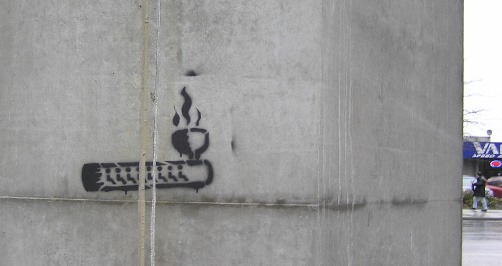
Though I confess, the meaning of this escapes me.





Surface light rail would have been feasible, but it would have raised some costs. The line uses third rail electrification, but overhead line could have been used for this section. Of course, the cars would have had to have pantographs as well as collector shoes but that is not unusual.
There would have been savings in that surface construction is cheaper than elevated – especially when you have a busway to build it in. But I suspect the real killer was that this would have required train priority at all crossings which would be anathema in this car oriented society.
Richmond also asked about a separate tram shuttle for No 3 Road but were told it would reduce ridership because of the transfer at the Casino.
It is also possible for trams to run in the street without OLE – both London and Washington DC had them – using a slot to run a “plough” collector just under the surface. Various other ways of doing it are technically possible including contacts which energise only when the tram is over them, and induction.
The problem with the Canada Line was that the outcome was chosen first then the “studies” were designed to support the desired outcome.
The “art” does not look spontaneous to me – that’s an Olympic torch and a symbol for rapid transit.
I’m going to need new glasses; that looked like drug paraphernalia at first glance.
Welcome back, Gordon!
It looked like drug stuff to me, too… and I think it is. Maybe it’s saying something about rapid transit being at the mercy of the politics behind the Olympics?
I don’t know what No. 3 road looked like before, but yikes. *Sigh.* Their loathsome mantra: “We don’t care how ugly or costly it is, as long as it doesn’t distrupt the driving of our precious cars.”
Question.. is there less crime in beautiful places? I don’t mean like an upscale neighbourhood (we all know what British Properties’ reputation is), but a community that’s well-designed as Kunstler would want it. Just thinking about what SkyTrain apparently brings to a community even if it’s just perception.
IMHO, No. 3 Road was uglier before.
Large Japanese cities like Kobe or Osaka have successfully, in my opinion, integrated elevated train lines into their urban spaces. Most areas underneath the tracks are turned into enclosed spaces with shopping or restaurants inside. Here is one in Kobe, running directly under the Japan Rail Kobe Main Line running through the heart of the city and continuing through Osaka where it has a similar treatment:
http://commons.wikimedia.org/wiki/Image:Kobe_sanchika01s3072.jpg
And they even put houses (yikes!) under them:
http://commons.wikimedia.org/wiki/Image:JR-motomachi-kokashita.jpg
Sorry, that first picture is actually *below* the shopping arcade I wrote about, but you get the idea.
Question: What happens if a LRV with both third rail and pantographs goes into a cut and cover tunnel? 🙂
You’ve uncovered the secret design for the Olympic torch – a true symbol of Vancouver – and of the “high” line.
++++
Anyways, I think they have done a good job of the elevated guideway down No. 3 Rd. – much smaller scale (lower height, no bents) than the meandering one down the Lougheed Highway which is too high in places and the bents and centre placement overshadow much more than the side-of-the-road placement.
In photos where the Canada Line is adjacent to buildings, the line blends well.
Trees will help break up the linearity, but blowing leaves on the tracks could cause safety concerns with wheel slip.
++++
The other concern with an at-grade allignment was the parameters set out by the bidders (plus price was more expensive) in their bids. Bombardier forced a transfer to streetcar for the at grade on No. 3 Rd. and SNCLavalin would have required most of the side street cross traffic to be blocked off.
See pages 10 and 11 here:
http://www.canadaline.ca/files/uploads/docs/doc177.pdf
Bombardier’s Alternate Proposal would have forced a transfer to a streetcar on No. 3 Rd. (not necessarily that bad a notion, as it would have provided the starter line for a Richmond-wide system, just that the heavy rail portion would hnot have reached the core).
The SNC Lavalin Alternate Proposal would have required:
So it may be fine and well to say you can build LRT down No. 3 Rd. with signal priority and keep cross traffic, etc.- but the bottom line is that that is not what was offered in the proposals put forth by the bidders.
Page 15 of that report summarizes the reasons why SNCLavalin’s Base Proposal was selected over SNCLavalin’s Alternate Hybrid Proposal:
Note that both of SNCLavalin’s bids were apparently lower priced than Bombardier’s two proposals.
Metros with a view – I’ll leave it up to the reader to figure whether they are well integrated:
http://mic-ro.com/metro/metroswithaview.html
Gord,
I work in Richmond and occassionally go to the No. 3Rd vicinity for lunch.
No. 3Rd. was always a very ugly place, most of the space where the Canada Line goes now used to be parking lots.
I happened to be where your photos were taken on Friday and had the impression that they could actually something with the space between the pillars which would be far better than what was there before (asphalt). Parks and public spaces could certainly liven the area up, and it doesn’t rain under a SkyTrain guideway…
I guess it all depends on what they do with the space when finished…
one of the coolest examples of cities working using elevated tracks to their advantage is in paris, at the barbès-rochechouart station in the north end of the city.
not every day, but often, one of the largest (and cheapest!) public markets in the city uses the tracks as a roof, so even when it’s a downpour, the city is still frequenting the stalls.
pretty awesome, no?
—
i’ll come right out and say it – it’s a hash pipe. yep! for real!