
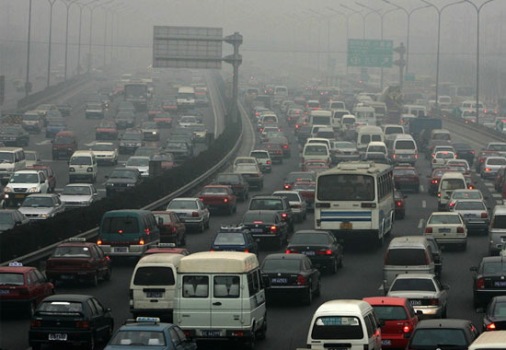
Or rather, “What are they thinking!?”
Cars and more cars: In China, car ownership at present is about 20 million, but is projected to be 250 million in 2020 (an 820% increase in a decade!), subject to the availability of a fuel.
‘Bigger is better:’ An overwhelming sense of the development projects is that the bigger they are the better they are. In Nanchang, building setbacks are to be over 120 m in new plans, just about twice that of the Champs Elysée.
‘What context?’ Compared to North America, the approach to development has a disconnect in terms of both sense of scale and regard for the surrounding context. The primary objective is to create a superb standalone development, regardless of its context in terms of either use or scale.
‘Seven stories is cool’ In a number of areas buildings were universally seven stories high, since that was the height one could build without elevators. Their orientation was such that there was ventilation through single-loaded units. While most people owned air- conditioners, frequently there was not enough energy available to use them! Therefore, the natural ventilation achieved with building orientation was critical.

– Philip Weinstein, a senior partner of Toronto-based firm The Planning Partnership, at a Lambda Alpha meeting in Phoenix.
Hasn’t anyone in China calculated the amount of land 250 million cars would require to drive and park, not to mention the consequences with respect to energy security, greenhouse gases, local air and noise pollution, traffic deaths and urban design? It seems they are metaphoricallly going to drive off a cliff, and the only question is how fast can they do it.





A quarter-billion vehicles is a staggering number. I imagine that in the coming decades the Chinese National Government will mount a herculean effort to provide road infrastructure to meet the exploding demand and yet will be faced with virtually all of the same obstacles and failures North America has experienced in the last fifty years of freeway culture. However unlike most North American jurisdictions there seems to be an intention in to provide rail-based transportation options within the major cities and intra-regional high speed rail connections.
The x-factor, as I see it, will be the degree to which the National Government will exert control over individuals’ transportation choices. From what I have seen in photos it seems much of the new China is not being built on a pedestrian scale. The planned spiderweb of subways in Beijing and Shanghai are astounding, but the roads are already full and the 800%+ increase in cars has barely begun. I think the recent traffic experiments in Beijing is a glimpse of things to come.
I returned from China a few months ago after a 1 month stay, and the thought of 250 million cars is so unbelievable that I will go out on a limb here and say: it will never happen.
Why? Well, as anyone who has been to China already knows, the streets are already completely packed with cars as it is, and even if the government could build enough road capacity to meet the predicted demand, they will undoubtably run into other problems which will halt more expansion. Among these issues are air pollution (already at critical levels – we saw 3 days of blue sky in 30, even in the countryside), fuel availability, and resource availability. All of these factors will come to a head before 250 million cars can be put on the road.
As for why the Chinese build grandiose stand-alone projects, I think we need to look not only into the national psyche but also the Chinese character. The communist legacy left the country with a “glory to the party” ethos which has now afflicted much of normal society. Building and new projects are not considered worthy if they aren’t huge, imposing structures that fit with the national ego. (Believe it or not, many Chinese think that their country is more advanced in many ways than the majority of developed nations.) Combine this with a culture where displays of wealth are de rigueur (clothes, watches, cars, houses) and you can see how big a role the individual ego plays in the design of new development.
Don’t believe the hype – even though China is growing increasingly wealthy and cars and malls are being built at a staggering rate, the country is a disaster waiting to happen.
I was in China last year and we impressed and shocked at the growth of the highway infrastructure. However there is also a commitment to planning and alternative transportation methods and in particular high speed trains. The MAGLEV line in Shanghai is very impressive and it is said will quickly be extended to Hangzhou and other nearby cities.
Clearly they are currently in love with the auto but they will not fall all the way into the US civic trap.
Just noticed there is an article on the growth of Chinese subway lines in the LA times – go to http://www.planitzen.com to read.
Shanghai will have the largest subway system in the world in a decade or so.
I lived in a small city (2 million person county being small) in China for 1 year. The city was full of 7-story buildings. Admittedly, I didn’t see as much sky as I do here because of the height, but that was the most compact city I have ever lived in. You could literally bike across the major city portion in an hour or so. I walked to everything I wanted to get to or took a taxi. Seven stories is a good height to get good density, but it also keeps the environment on a more pedestrian and livable scale.
I went back a few years ago and there was a taxi strike at the time. The city was empty and bare of cars, but the city still seemed to function all right.
If the Chinese continue down the current path of infrastructure development, they’ll ruin some perfectly good compact cities.
Seven stories really are cool.
Henry – if only a 10 minute taxi ride here cost $1!!