

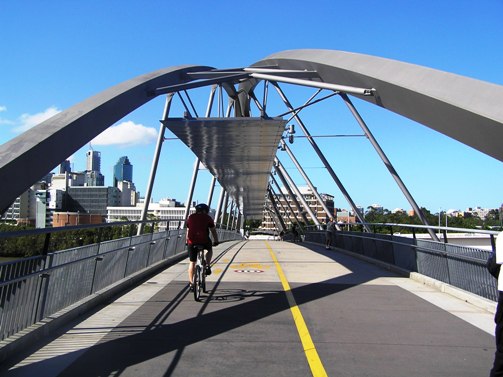
In Price Tags 93, you can find examples of the new kind of pedestrian and bike bridges being built in Australia. Like this one in Brisbane:
Peter Berkeley, Queensland’s bike and ped planner, has been on an international tour to check out cycling facilities, and he made a special trip up to Newcastle in England to see the Gateshead Millennium Bridge:

In order to allow small craft to sail beneath, the bridge actually tilts, like this:

You can see why it has become a tourist attraction in its own right, nicknamed the “Blinking Eye Bridge.”
As the debate over the Burrard Bridge continues (whether to widen the sidewalks, take some traffic lanes, not spend the ever-escalating amount – maybe $15 million, maybe $30 million), perhaps it’s time to consider the alternative: build a special ped/bike bridge across False Creek.
Discussion never gets very far because the centre of the creek comes under federal control as a navigable waterway, and the height of sailboats at high tide requires a high-level bridge, or some kind of drawbridge. But maybe it’s time to face up to the trade-off: why should a relative handful of recreation boaters be able to trump a necessary and safe crossing for the most sustainable form of transportation possible?
Or maybe we can do a drawbridge after all.
These kind of bridges, after all, are becoming popular all around the world – designed by the Fosters and Calatravas who merge engineering and architecture into art. They become icons for their cities.
Maybe it’s time for us.





We could use a bridge like that in Victoria in the Rock Bay neighbourhood north of the Downtown core.
A mid level drawbridge the height of the Cambie Bridge would allow the majority of boat traffic through without raising the drawbridge (i.e. barges, etc.). Otherwise, the number of boats running through the creek would be prohibitive.
Remember that when a drawbridge is open, it also prevents pedestran/bike traffic too – so it is a balancing act. Historically, that has lead to high level bridges for auto traffic – maybe pedestrians and bikes are more tolerant of delays caused by bridge openings.
The railway tresstle bridge across False Creek was only removed in abuot 1985 or so, so conceivably, boat traffic can live with a drawbridge in place. But I don’t know what the the ratio of open to closed time was. I suspect that with the deommissioning of the False Creek railyards, it must have been left open a lot of the time towards the end of its life.
The natural place for a crossing would be between the main piers under the Burrard Bridge – which was originally designed for a drawbridge span for railways.